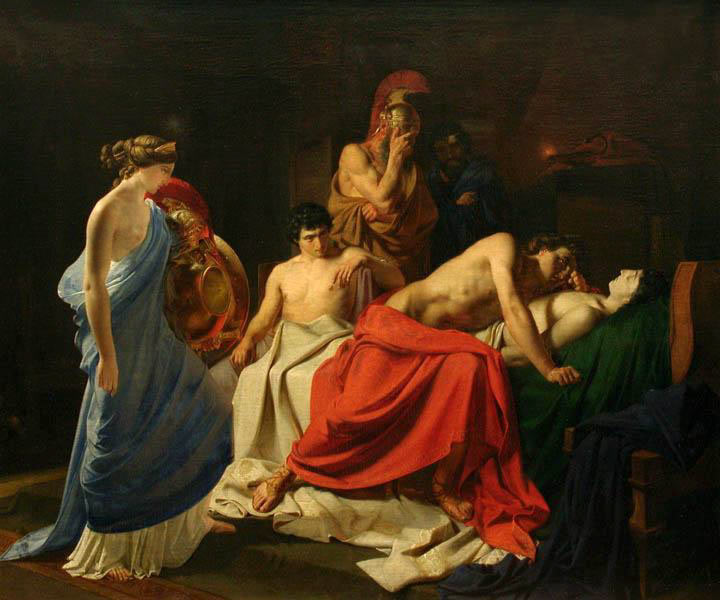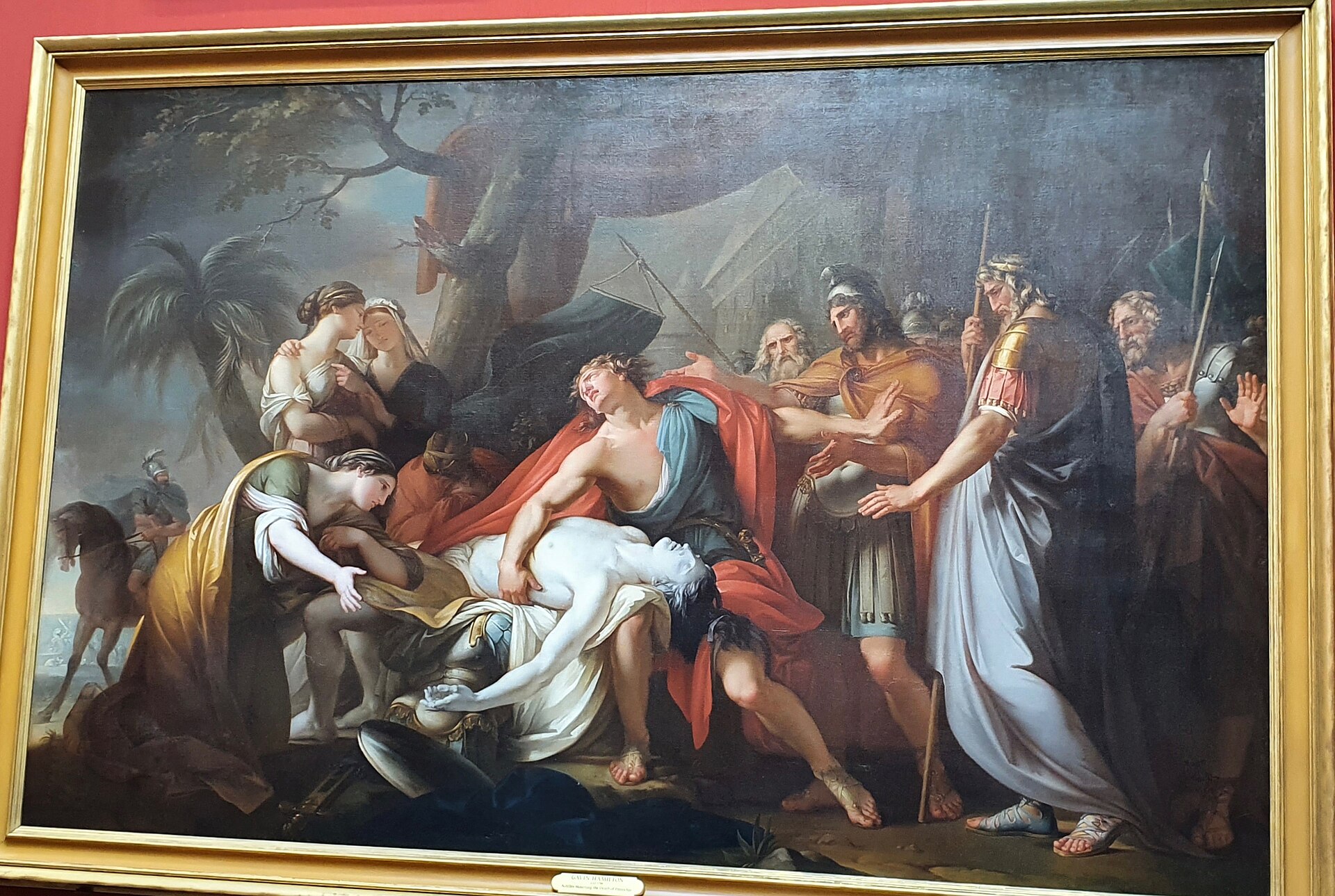
Achilles Lamenting the Death of Patroclus
Patroclus lies dead, and Achilles throws himself toward the body in a storm of grief while comrades hold him back and mourning women raise their arms. The composition reads left to right like a sculpted frieze — grief passing through a chain of bodies.
Hamilton painted this in Rome as part of a six-picture Iliad cycle, one of the earliest attempts anywhere to paint Homer in the new, severe classical style. Engravings of the series circulated across Europe and quietly shaped how a whole generation — including Jacques-Louis David — imagined the ancient world.
News of Patroclus's death reaches Achilles, and he breaks. He pours dust on his head and claws at the ground; his cry is so terrible that his mother hears it at the bottom of the sea. The quarrel with Agamemnon, the prizes, the pride — none of it matters anymore.
Thetis comes to him and tells him the price: if he kills Hector, his own death follows soon after. Achilles accepts on the spot. His rage at Agamemnon has found a new and final target. He has no armor — Hector is wearing it — but he walks to the trench unarmed, and Athena sets a flame around his head. He shouts three times, and the Trojan army stumbles backward in terror.
Gavin Hamilton (1723–1798) was a Scottish painter, archaeologist, and art dealer who spent most of his life in Rome. Digging at Hadrian's Villa by day and painting Homer by night, he became one of the fathers of Neoclassicism, though his influence spread mainly through prints of his work.