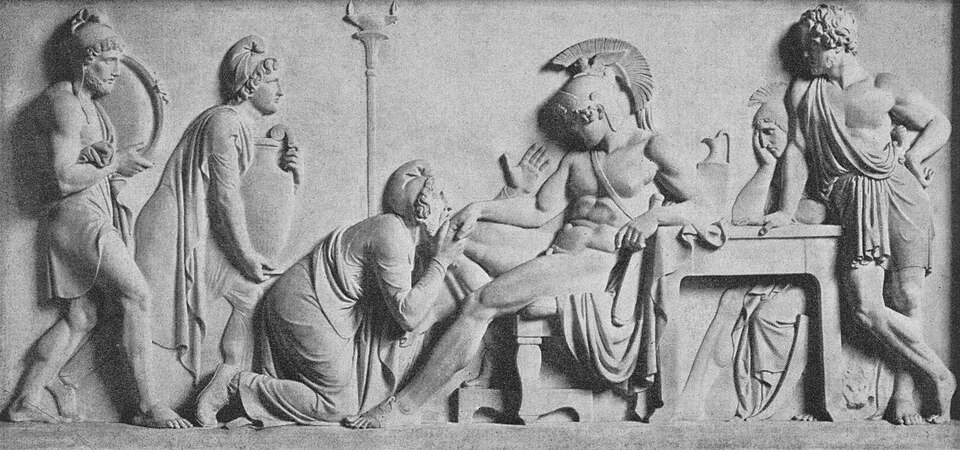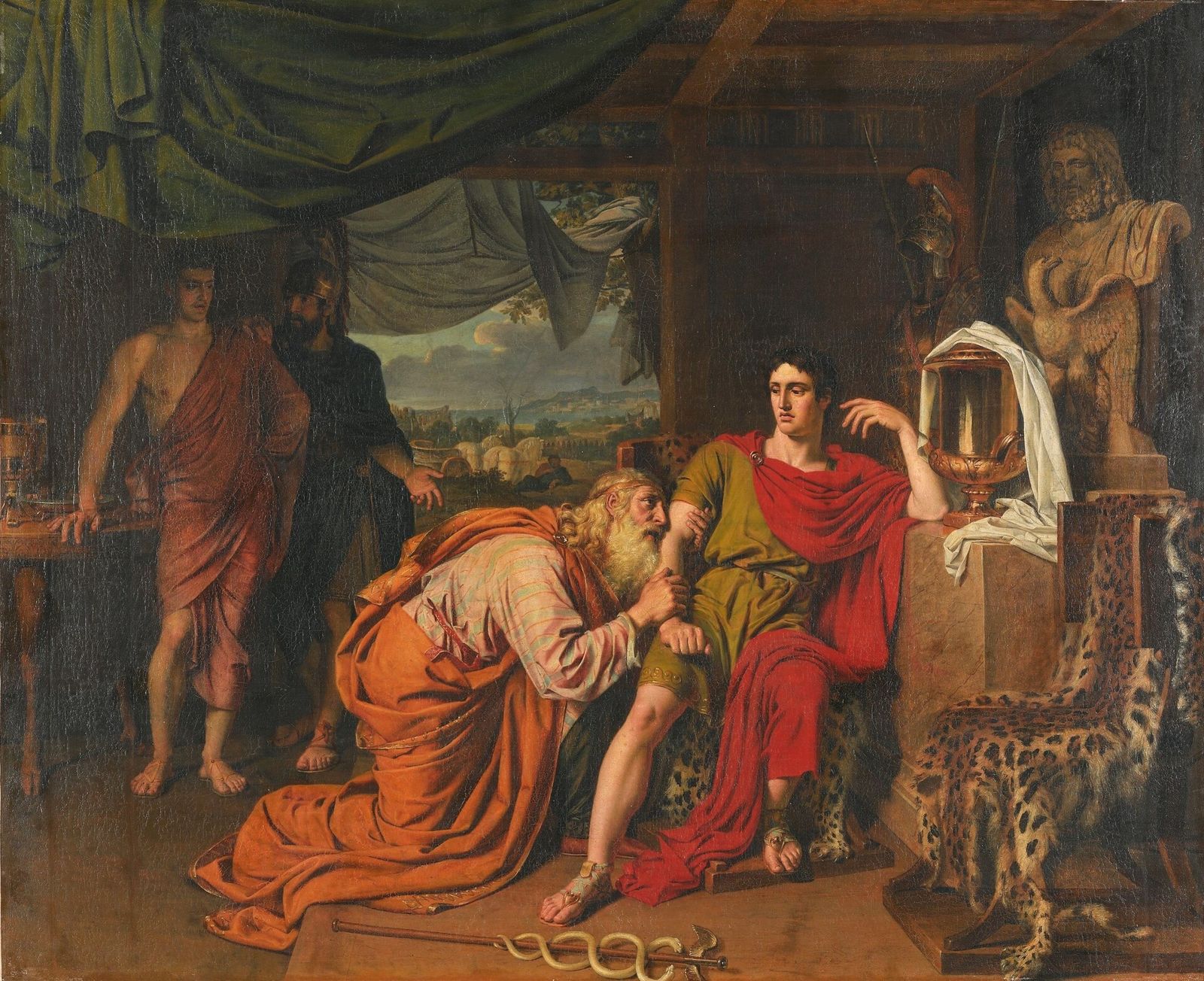
Priam Asking Achilles to Return Hector's Body
Old King Priam has slipped into the Greek camp by night to beg for the body of his son Hector. He kneels and clasps the hand of the man who killed him. Achilles, who has just been reminded of his own aging father, looks away, caught between rage and pity.
Ivanov painted this at eighteen as a medal piece for the St. Petersburg Academy, and it already shows his gift for the psychology of a charged pause — no violence, just two enemies deciding whether to weep together. Homer's poem ends in exactly this mercy, and Ivanov trusts the quiet.
Patroclus is burned on a great pyre, and Achilles holds funeral games in his honor — but he still cannot sleep, and Hector's body still lies by his tent. On Olympus, the gods decide it has gone on long enough. Zeus sends word to both sides: Achilles will accept a ransom, and Priam will bring it.
So the old king of Troy loads a wagon with treasure and drives at night, alone, into the enemy camp — guided, unseen, by the god Hermes. He walks into Achilles' shelter, kneels, and kisses the hands that killed his son. He asks Achilles to think of his own father, an old man who will also wait for a son who is never coming home.
It works where nothing else could. Achilles thinks of Peleus and starts to cry — Priam crying with him, each man weeping for his own dead. Achilles returns the body, and the two enemies share a meal. The Iliad does not end with the wooden horse or the fall of the city. It ends here: with a funeral truce, and Troy burying Hector, tamer of horses.
Alexander Ivanov (1806–1858) spent most of his life in Rome working on a single gigantic canvas, 'The Appearance of Christ Before the People,' which took him twenty years. Russian painters revered him as the model of total, almost monastic devotion to art.