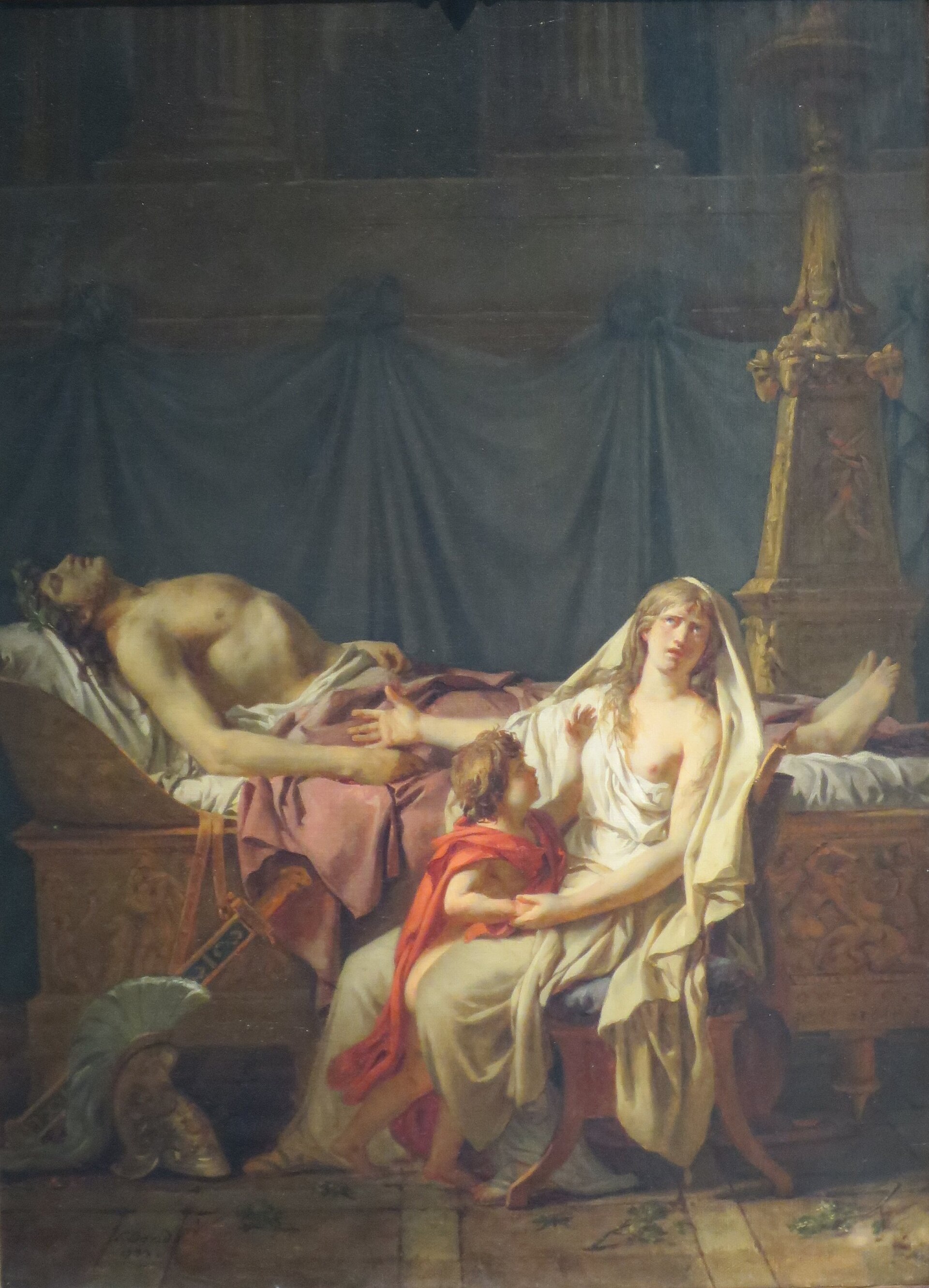
Andromache Mourning Hector
_by_Jacques-Louis_David,_1783,_Pushkin_Museum.JPG)
Hector's body lies laid out on its bier, lit by a tall candelabrum. His widow Andromache sits beside it, one hand raised in exhausted grief, while their small son Astyanax reaches up to touch her — too young to understand, old enough to be frightened.
David painted this in 1783 as his reception piece for the French Royal Academy, and it is a lesson in subtraction: no battle, no crowd, just a widow, a child, and a corpse in a dark room. The severe staging and moral seriousness announce the style that would soon make David the painter of the Revolution.
Andromache is at home weaving and heating bathwater for Hector when she hears the screaming from the walls. She runs up, sees her husband's body behind Achilles' chariot, and faints. When she comes to, she speaks the poem's bleakest speech — not about love, but about what happens next: a widow in a doomed city, and a fatherless boy whom no one will protect.
She is right about all of it. When Troy falls, the victors will throw her son Astyanax from the walls, and Andromache will be handed to the son of Achilles as a slave. Homer's audience knew this; the grief in this scene is for things that have not happened yet.
Jacques-Louis David (1748–1825) reinvented French painting around discipline, sacrifice, and Rome, then put that style to work for the Revolution and for Napoleon. Exiled after Waterloo, he died in Brussels, the most influential European painter of his age.