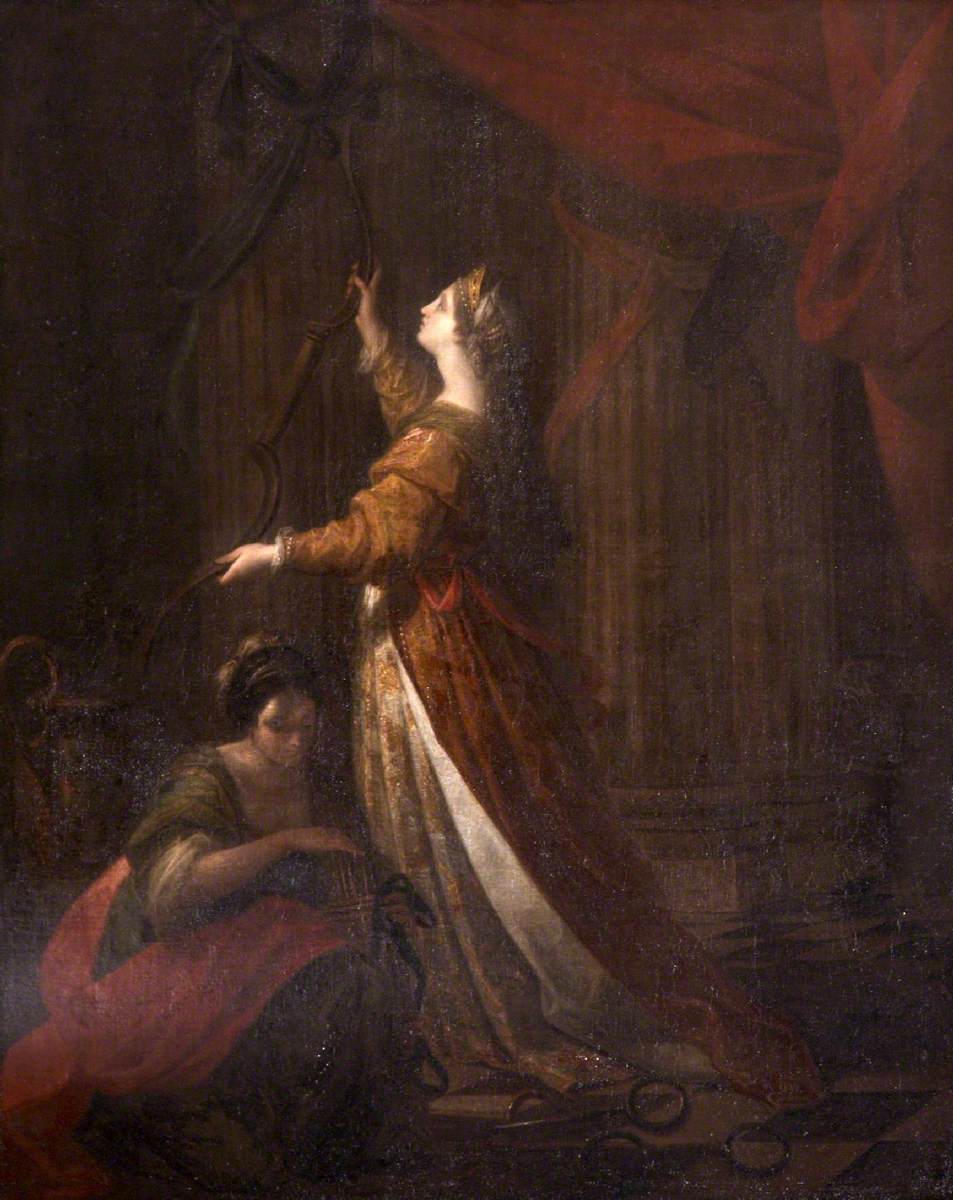
Penelope Taking Down the Bow of Ulysses
_-_Penelope_Taking_Down_the_Bow_of_Ulysses_-_872173_-_National_Trust.jpg)
Penelope lifts the great bow of Odysseus down from its peg, where it has hung untouched for twenty years. Her face is turned away in sorrow: taking the bow down means the contest she has dreaded, and, she believes, giving up on her husband's return.
Kauffman paints the moment as private grief rather than public ceremony — no suitors, no hall, just a woman alone with an object that stands for an absent man. The painting hangs at Saltram in Devon alongside its companion piece, Hector taking leave of Andromache, which appears earlier in this collection.
Penelope — out of time, and perhaps sensing something she cannot name — announces a contest. Servants carry out the great bow of Odysseus, untouched for twenty years. She will marry the man who can string it and shoot an arrow through the sockets of twelve axe-heads set in a line, a trick shot her husband used to perform.
One by one the strongest suitors warm the bow at the fire, grease it, strain at it — and cannot even bend it. Then the beggar by the door asks for a try, and the hall erupts in outrage. Telemachus insists, having first sent his mother upstairs and quietly locked every weapon out of the hall. Odysseus turns the bow over in his hands like a craftsman checking his tools, strings it as easily as a bard strings a lyre, and — still sitting on his stool — sends the arrow through all twelve axes.
Angelica Kauffman (1741–1807) was a Swiss-born painter who made her career in London and Rome and became one of the most successful women artists of the eighteenth century. She was a founding member of the Royal Academy and returned to Homer's heroines throughout her career.