Ulysses and Telemachus Slaughter the Suitors
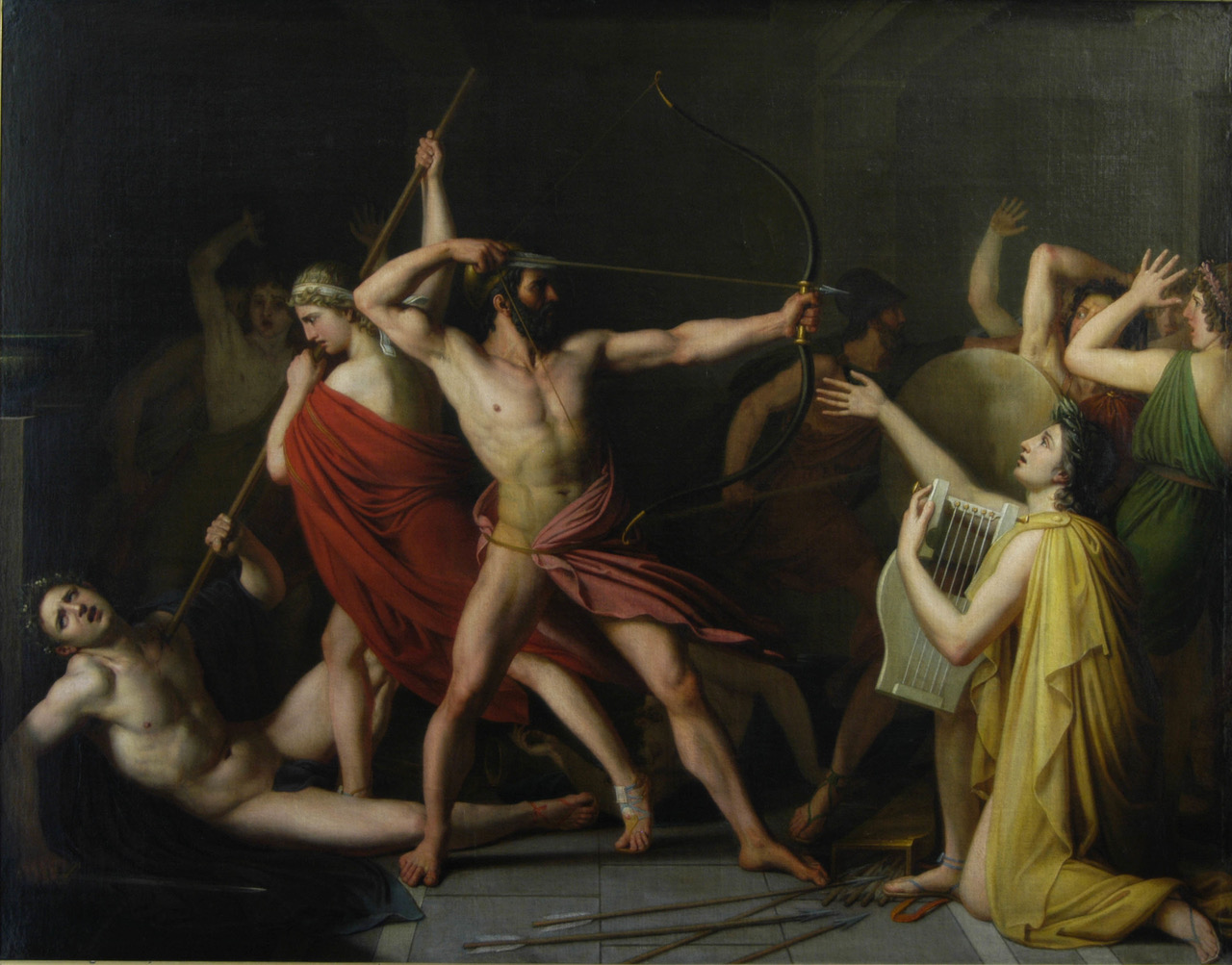
The disguise is off. Odysseus stands with his bow amid overturned tables and fallen men, and beside him fights Telemachus, the son who was an infant when he sailed for Troy. The trapped suitors scramble for cover at the edges of the hall.
Degeorge stages the massacre like a piece of classical theater — bodies arranged in a frieze, the hero lit at the center. Painted in 1812, it carries the stern, muscular style of the school of David into Homer's bloodiest scene.
The second arrow goes through the throat of Antinous as he lifts a golden wine cup. For a moment the suitors think it is a shooting accident. Then the beggar throws off his rags, and names himself, and the hall understands: the man they have robbed for years is standing in the only doorway with a full quiver.
They have numbers; he has the locked door, the bow, Telemachus, two loyal herdsmen, and Athena. Homer gives the fight the full, unsparing brutality of an Iliad battle, fought indoors among the dinner tables. By the end every suitor — more than a hundred men — is dead, the disloyal maids are hanged, and the hall is fumigated with sulfur. Poseidon's curse has run its course exactly: he has come home late, alone, and to trouble.
Thomas Degeorge (1786–1854) was a French Neoclassical painter trained in the circle of Jacques-Louis David. He spent most of his career in his native Clermont-Ferrand, which preserves the best collection of his work.