Penelope at Her Loom with Telemachus
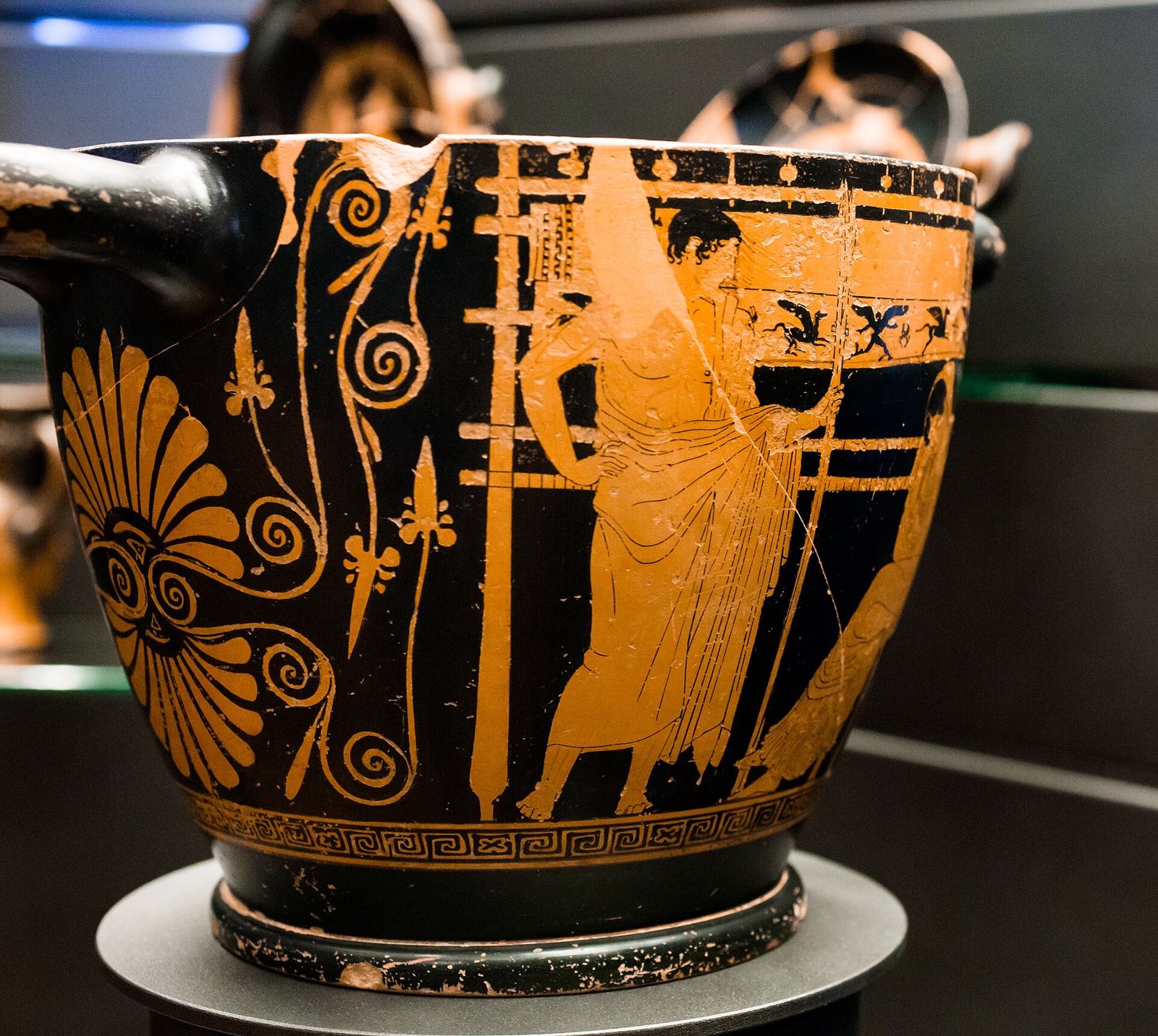
Penelope sits on a stool in front of her loom, legs crossed, chin dropped into her hand — the ancient pose of grief. Behind her stands her son Telemachus with two spears, old enough now to be angry. On the loom hangs the unfinished cloth she secretly unpicks each night.
This little cup, painted around 440 BC, is the most famous ancient image of Penelope, so central that scholars named its anonymous artist 'the Penelope Painter' after it. The drooping head says everything the vase cannot.
The story now turns to what he comes home to. His wife Penelope has held Ithaca together alone for twenty years, with no proof her husband is alive or dead. For years, more than a hundred young nobles have occupied her palace as unwanted suitors, demanding she declare Odysseus dead and marry one of them — and eating and drinking the kingdom's wealth while they wait.
Her famous defense is a loom. She announces she will remarry once she finishes weaving a burial shroud for Laertes, her aging father-in-law. All day she weaves in public view; at night, by torchlight, she secretly unpicks the day's work. The trick holds the suitors off for three years before a maid betrays her. Homer means the marriage of Odysseus and Penelope to be a marriage of equals: he survives abroad by inventing stories, she survives at home by weaving and unweaving one.
The Penelope Painter was an Athenian red-figure vase painter active around 440 BC, known for quiet, emotionally precise scenes. His real name is lost; he is called after this very image of Penelope at her loom.