Penelope Unraveling Her Web
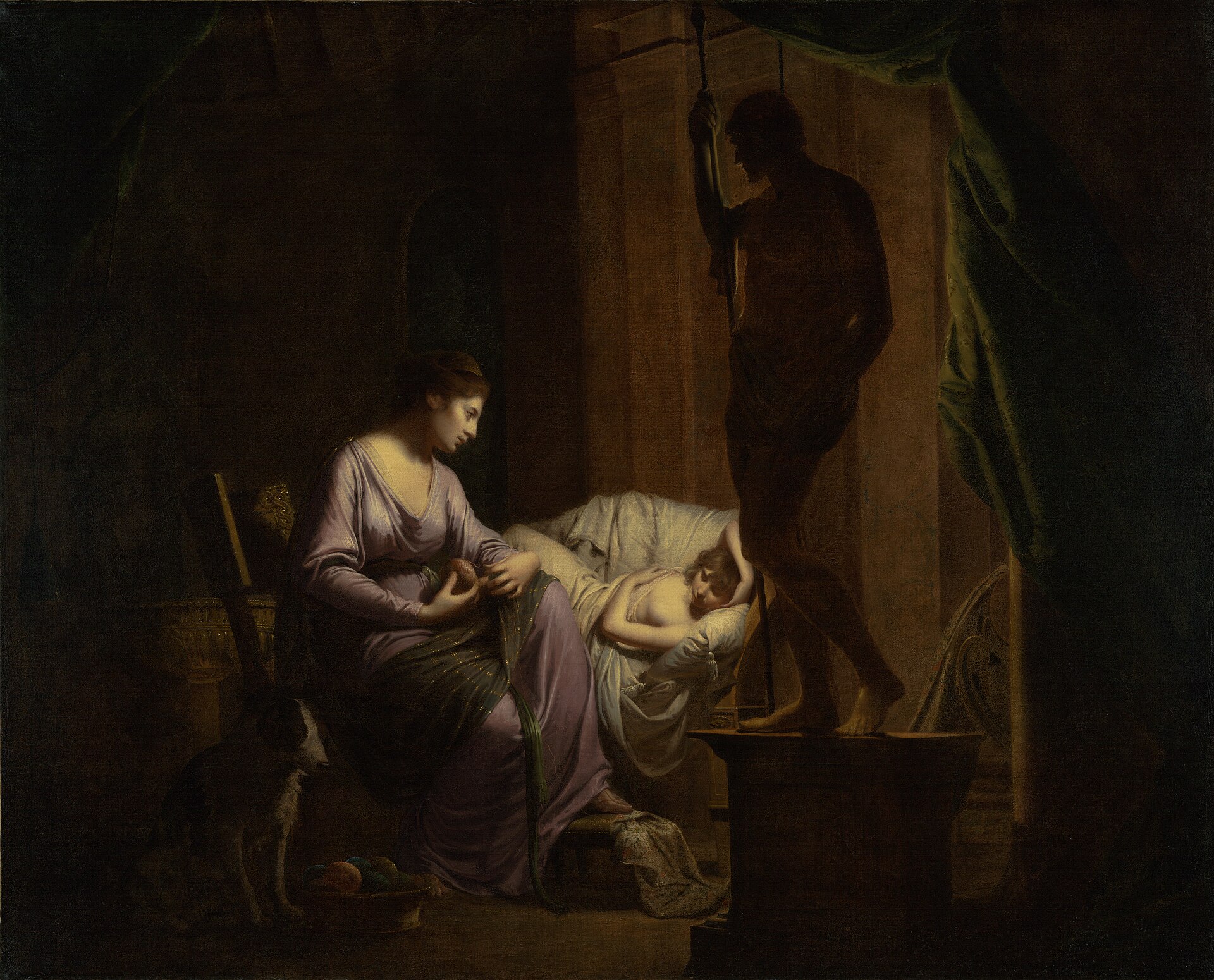
It is deep night on Ithaca. By lamplight, Penelope picks apart the shroud she wove during the day — the trick that holds her suitors off, since she promised to remarry when the cloth is finished. Her son sleeps beside her, and a statue of her absent husband stands in the shadows.
Wright was the great English painter of candlelight, and he uses it here to turn a domestic scene into something secret and tense. The glow falls on the unraveling threads: one small lamp, one small act of resistance, repeated for years.
The story now turns to what he comes home to. His wife Penelope has held Ithaca together alone for twenty years, with no proof her husband is alive or dead. For years, more than a hundred young nobles have occupied her palace as unwanted suitors, demanding she declare Odysseus dead and marry one of them — and eating and drinking the kingdom's wealth while they wait.
Her famous defense is a loom. She announces she will remarry once she finishes weaving a burial shroud for Laertes, her aging father-in-law. All day she weaves in public view; at night, by torchlight, she secretly unpicks the day's work. The trick holds the suitors off for three years before a maid betrays her. Homer means the marriage of Odysseus and Penelope to be a marriage of equals: he survives abroad by inventing stories, she survives at home by weaving and unweaving one.
Joseph Wright of Derby (1734–1797) made his name with dramatic candlelit scenes of science and industry, like the famous Experiment on a Bird in the Air Pump. He brought the same fascination with artificial light to subjects from history and myth.