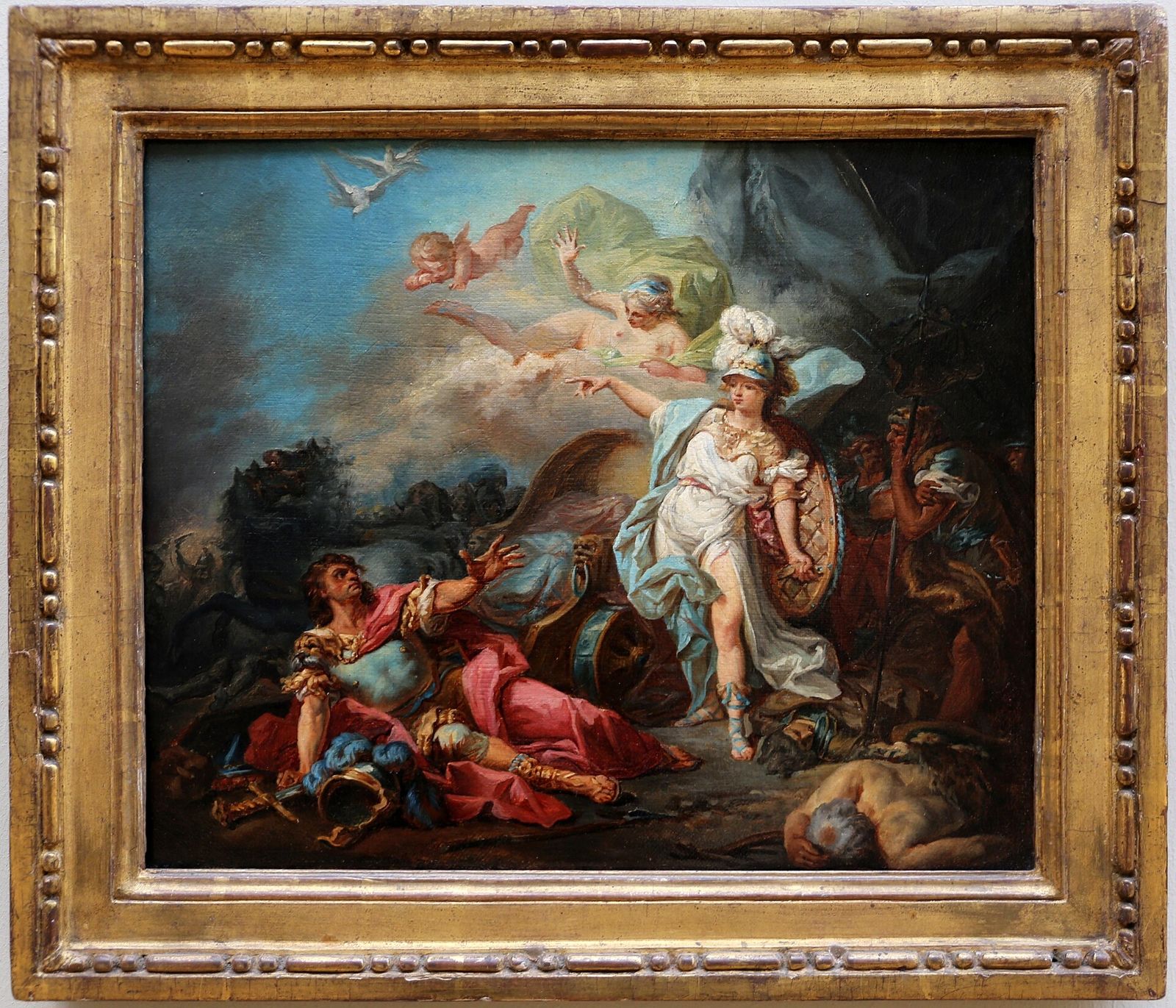
The Combat of Mars and Minerva

The gods themselves have joined the fighting at Troy. Minerva, goddess of disciplined war, has just flattened Mars, the god of raw violence — he sprawls back among the clouds while she stands over him, and a goddess sweeps in overhead on a bank of cloud.
David painted this at twenty-three for the Prix de Rome competition of 1771, and it is fascinating precisely because it looks nothing like the severe David to come: the palette is pastel, the bodies airy, the whole thing still perfumed with the rococo style he would later declare war on. It is the revolutionary painter before his revolution.
The gods of Olympus are not spectators in this war. They take sides, argue, cheat, and sometimes wade into the fighting themselves. Hera and Athena work for the Greeks; Aphrodite, Apollo, and Ares fight for Troy; Zeus tries to hold the balance while secretly tipping it.
At the war's climax Zeus lifts all restraints and lets the gods fight openly — Athena flattens Ares, the war god himself, with a boulder. Artists loved these divine brawls: gods in armor, colliding above the human slaughter like weather.
Jacques-Louis David (1748–1825) became the defining painter of the French Revolution and then of Napoleon's empire, turning stern classical form into political statement. His studio trained much of the next generation of European painters, including Ingres.