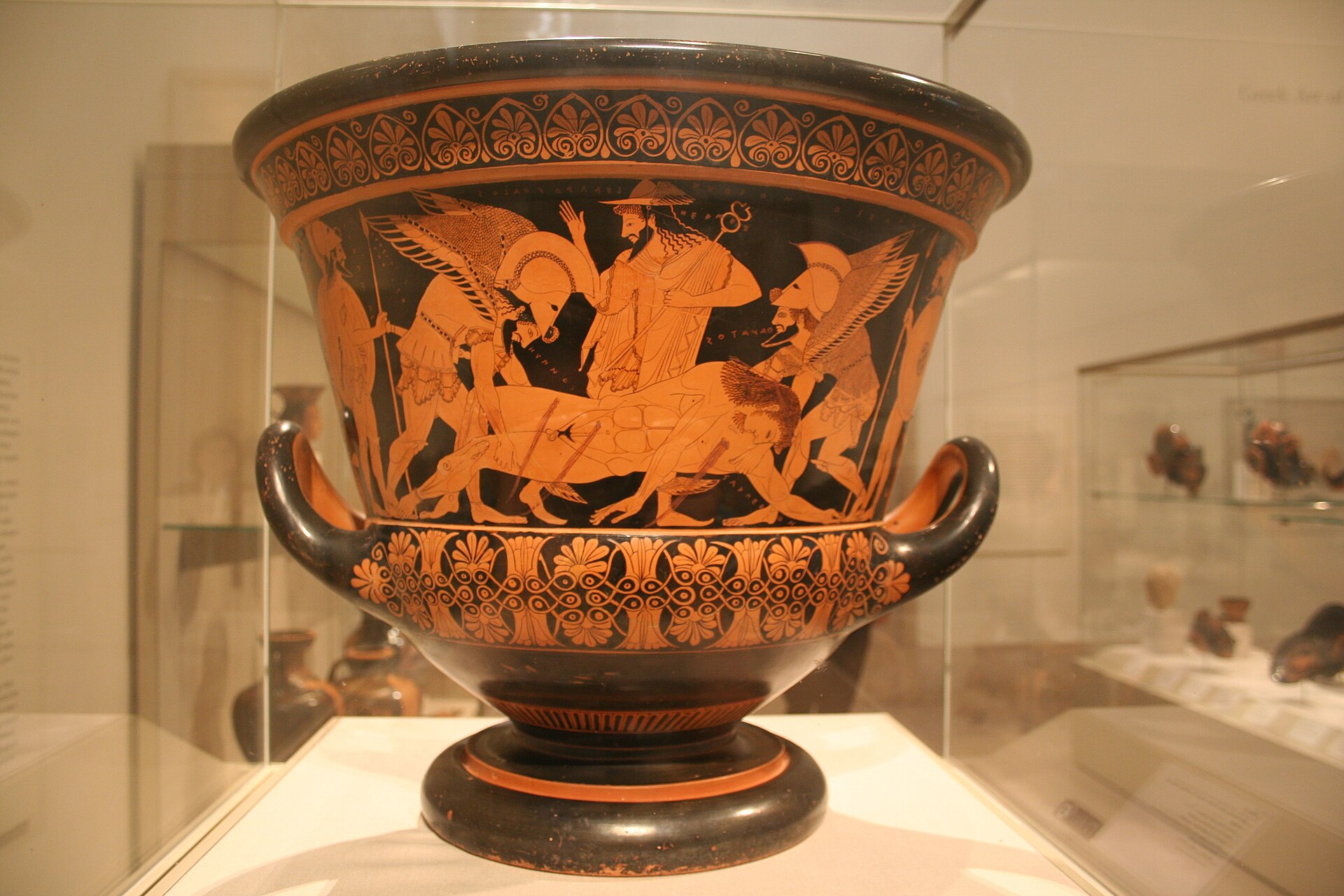
The Death of Sarpedon (Euphronios Krater)
.jpg)
Sarpedon, a son of Zeus fighting for Troy, has been killed by Patroclus — and Zeus, bound by fate, let it happen. On the vase, blood still streams from his wounds as the winged brothers Sleep and Death lift his heavy body from the field. The god Hermes stands between them, directing the rescue, so that Sarpedon can be carried home to Lycia for burial.
Euphronios signed this krater around 515 BC, and it is often called the finest Greek vase in existence: every muscle of the dying man is drawn with a draftsman's precision that was brand new at the time. The vase was looted from an Etruscan tomb in the 1970s, sold to the Metropolitan Museum for a then-record price, and finally returned to Italy in 2008 after a famous restitution battle.
With Achilles still refusing to fight, the Trojans breach the Greek wall and start burning the ships. Achilles' closest friend, Patroclus, can't bear to watch. He begs Achilles: if you won't fight, lend me your armor — the sight of it alone may scare the Trojans back. Achilles agrees, with one warning: drive them from the ships, then stop.
Patroclus, wearing Achilles' armor, sweeps the Trojans back from the ships and kills Sarpedon — a Trojan ally who is a son of Zeus himself. Zeus watches from Olympus and considers saving him, but Hera talks him out of it: every god has mortal children in this war, and the rules must hold even for the king of the gods.
So Zeus lets his son die. He sends the twin spirits Sleep and Death to lift Sarpedon's body from the battlefield and carry it home to Lycia for burial. It is the war's gentlest image of its hardest rule: not even Zeus can exempt the people he loves.
Euphronios was an Athenian vase painter and potter active around 520–470 BC, a leader of the so-called Pioneer Group who pushed the new red-figure technique toward real anatomy, foreshortening, and emotion. He is one of the few ancient painters whose signed works survive.