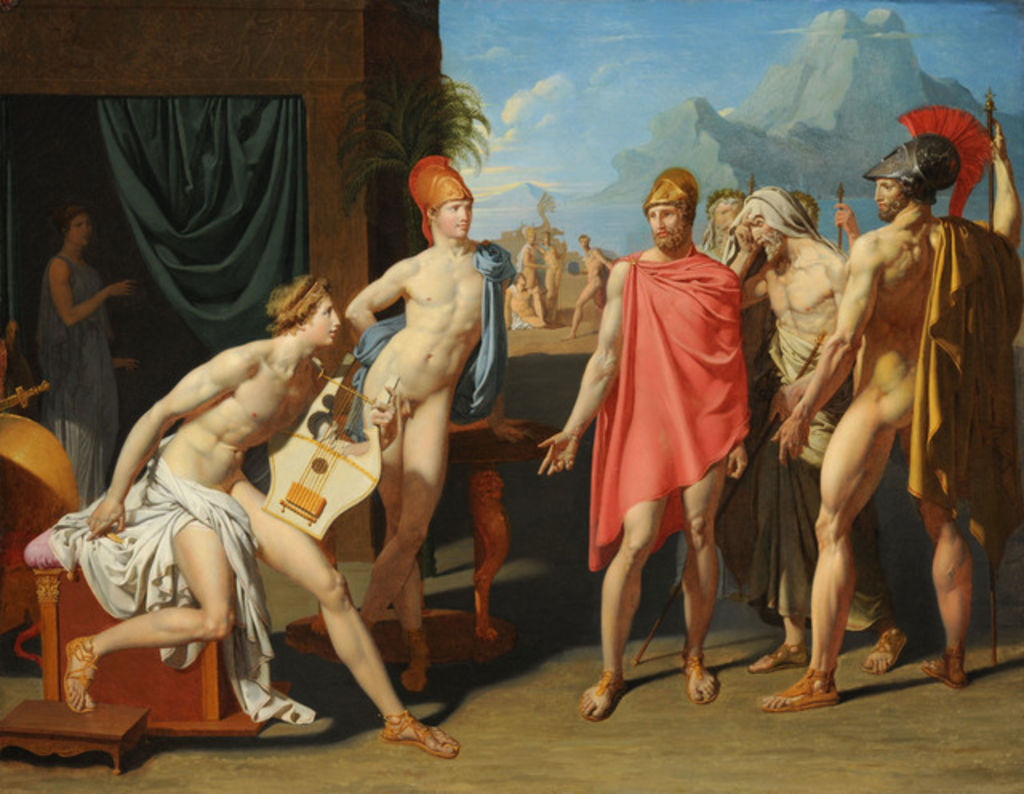
The Ambassadors of Agamemnon in the Tent of Achilles

The Greek war effort is collapsing, so Agamemnon sends an embassy — Ulysses, Ajax, and old Phoenix — to beg Achilles to return. They find him doing the last thing anyone expected: playing the lyre by his tent, singing of heroes' glory, with his friend Patroclus standing quietly beside him.
This canvas won the 21-year-old Ingres the Prix de Rome in 1801. He builds the picture as a confrontation of bodies: the tense, armored ambassadors on one side, the relaxed, nearly nude Achilles on the other, with the fleet of ships waiting behind them. The sculptor John Flaxman, then Europe's authority on Homer, reportedly called it the finest thing he had seen from the French school.
Zeus keeps his promise to Thetis. The Trojans push the Greeks back across the plain, and for the first time in ten years, Hector's army camps in the open, their watchfires burning within sight of the Greek ships. The Greeks are one bad day from being driven into the sea.
Agamemnon cracks. He sends an embassy to Achilles' tent — Odysseus the talker, old Phoenix who helped raise Achilles, and the warrior Ajax — with a staggering offer: treasure, cities, Briseis returned untouched, and one of Agamemnon's own daughters in marriage. Achilles hosts them politely, then refuses everything. No amount of treasure, he says, is worth his life. The embassy walks back through the dark with nothing.
Jean-Auguste-Dominique Ingres (1780–1867) trained under Jacques-Louis David and went on to lead the classical school of French painting, prizing drawing and contour above all. He spent long years in Italy and returned to Homeric subjects throughout his career, treating Homer as painting's holy scripture.