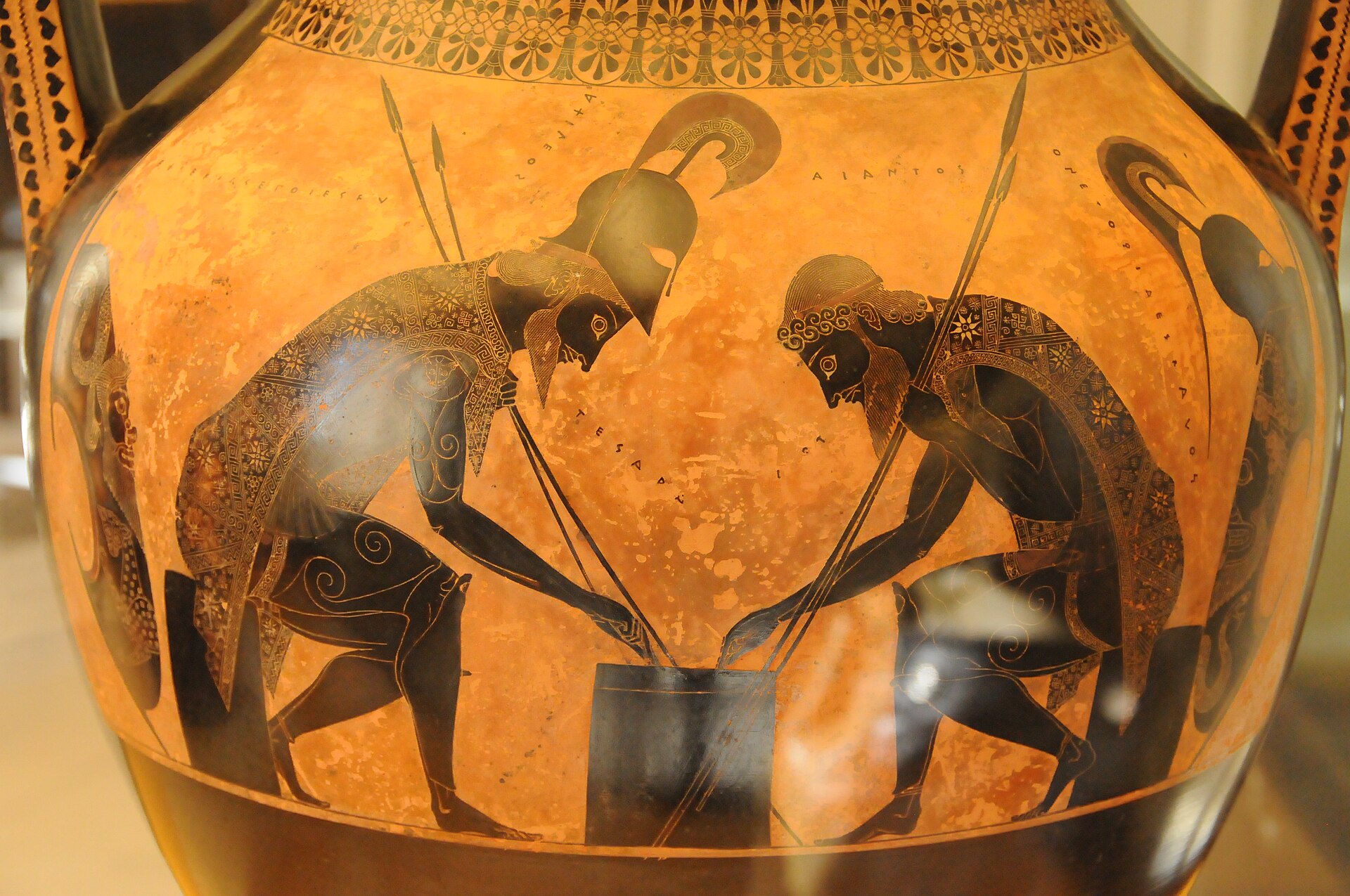
Achilles and Ajax Playing a Game
Nine years into the siege, in a quiet hour, the two greatest Greek warriors bend over a board game. Inscriptions by their mouths record their calls — Achilles says "four," Ajax "three." Achilles keeps his helmet on; Ajax has set his aside; both hold their spears. War waits just outside the frame.
The scene appears nowhere in Homer — Exekias apparently invented it, and it became one of the most copied images in Greek art. The tension is the point: Achilles wins the game and will win glory; Ajax, one point behind here, will lose the contest for Achilles' armor and die by his own hand. A whole double tragedy, folded into a tabletop.
Troy does not fall quickly. It is a rich, walled city on the coast of what is now Turkey, ruled by the old king Priam, defended by his son Hector — the greatest of the Trojan warriors, as Achilles is the greatest of the Greeks. The siege grinds on for nine years.
Homer's Iliad skips almost all of this. The poem covers only a few weeks in the tenth year. But ancient artists loved imagining the long dull stretches of the war — including the greatest Greek fighters, Achilles and Ajax, hunched over a board game between battles, killing time instead of Trojans.
In the tenth year, the Greeks are raiding towns around Troy for supplies and captives. Two captive women come back from one of these raids: Chryseis, awarded to Agamemnon, and Briseis, awarded to Achilles. Everything in the Iliad follows from these two prizes.
Exekias was an Athenian potter and painter active around 545–530 BC, and is regarded as the finest master of the black-figure style. He signed his work — this amphora bears his name — and brought a psychological depth to vase painting that no one had achieved before.