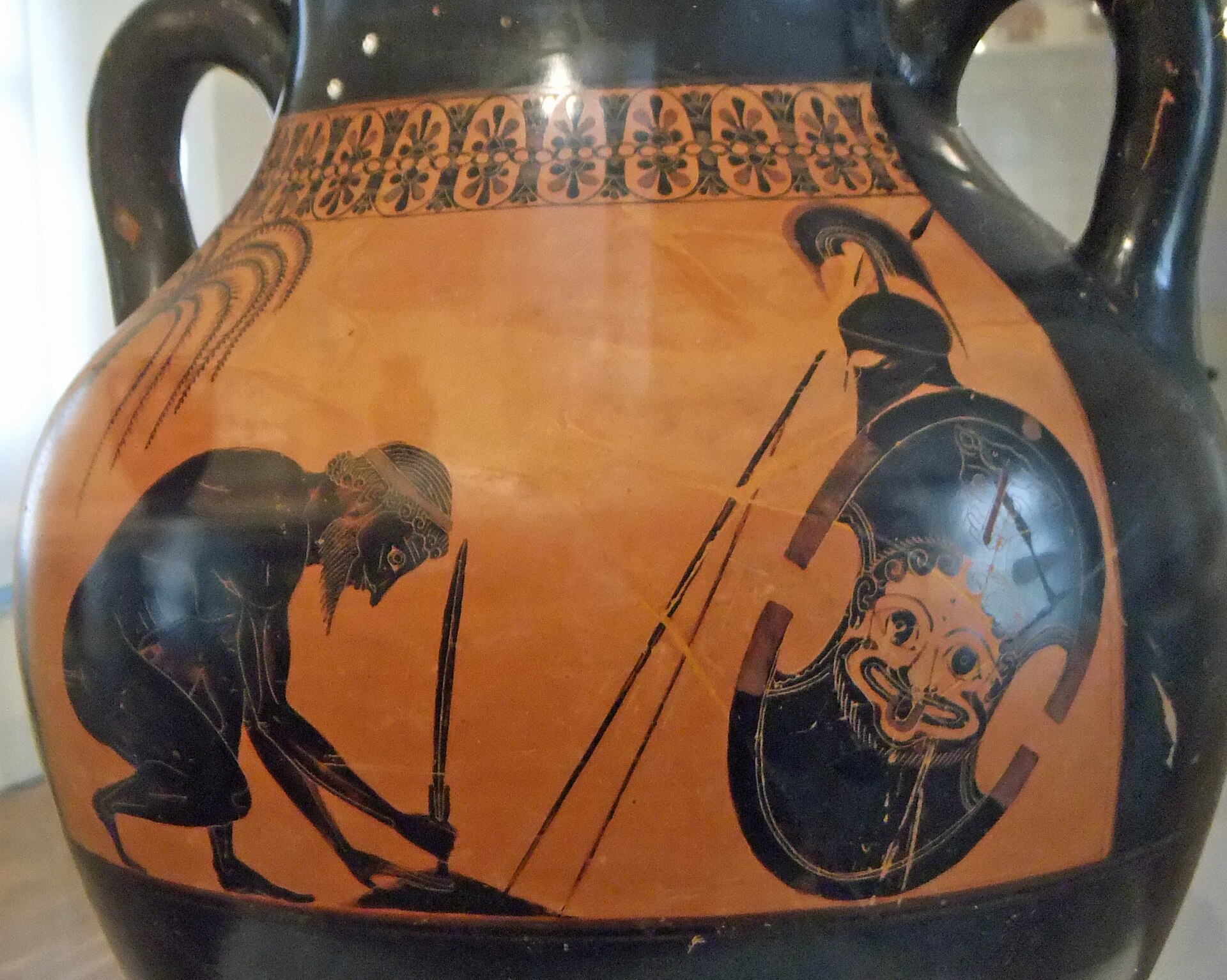
The Suicide of Ajax

After Achilles' death, his armor was awarded to Odysseus rather than Ajax, and the humiliated hero resolved to die. Exekias paints the moment no one else dared: Ajax alone, crouched under a palm tree, patting the earth firm around his planted sword so that he can fall on it. His helmet and shield stand stacked to one side, neatly, like clothes folded before a swim.
Every other ancient painter showed the death itself; Exekias shows the preparation, which is far worse. The stooped back, the careful hands, the waiting armor — it is one of the first true psychological images in Western art, painted on a wine jar around 530 BC.
With Achilles dead, his divine armor must go to someone. The two claimants are Ajax — the huge, steady fighter who carried Achilles' body off the field — and Odysseus, the talker. The Greek leaders hold a vote, and the armor goes to Odysseus. For Ajax, who has spent ten years being the army's human wall, it is an unbearable verdict on his worth.
That night Athena strikes him with madness. Meaning to kill the leaders who wronged him, he slaughters a field of sheep and cattle instead. At dawn he comes to his senses surrounded by butchered animals — the strongest man in the army, made ridiculous. He walks to the shore, plants his sword hilt-down in the earth, and falls on it.
Exekias was the finest of all Athenian black-figure vase painters, active around 545–530 BC, and signed his work as both potter and painter. He had a unique gift for finding the still, loaded moment inside a famous story rather than its noisiest one.