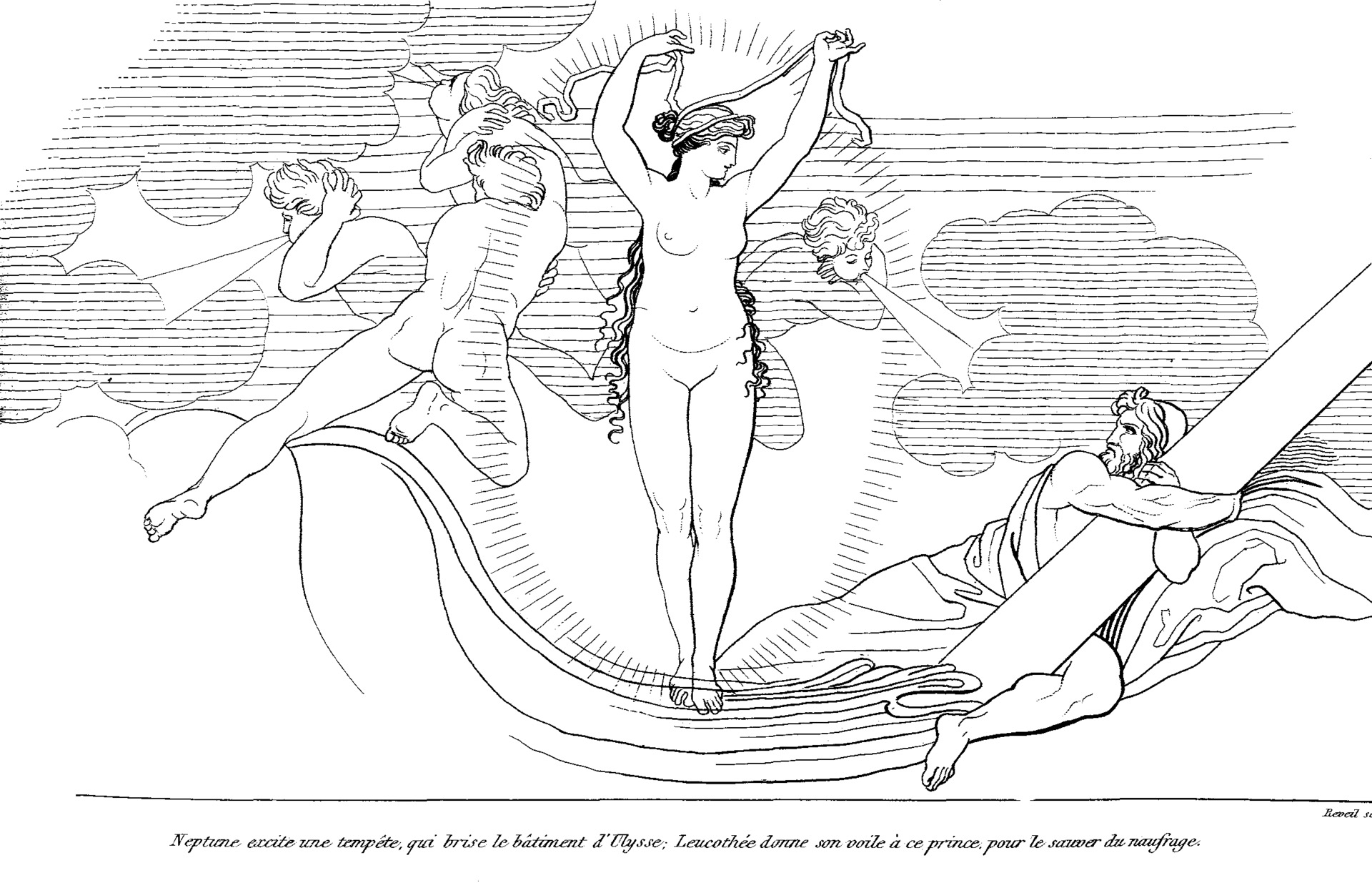
Leucothea Preserving Ulysses
In a few unbroken lines, Flaxman draws the shipwrecked Odysseus on his raft as the goddess Leucothea rises from the waves to hand him her life-saving veil. There is no shading, no color, no background sea — just outline.
That bareness was deliberate. Flaxman wanted the clarity of Greek vase painting, and his Homer outlines, engraved in 1793, became some of the most copied images in Europe. Artists from Goya to Ingres kept them on their shelves.
On Olympus, the goddess Athena — Odysseus's constant protector — finally forces the issue, and Zeus sends Hermes, the messenger god, to order Calypso to release her prisoner. She protests the gods' double standard bitterly, then gives in with grace: tools, timber, provisions, a favoring wind. Odysseus builds a raft with his own hands and sails alone for seventeen days.
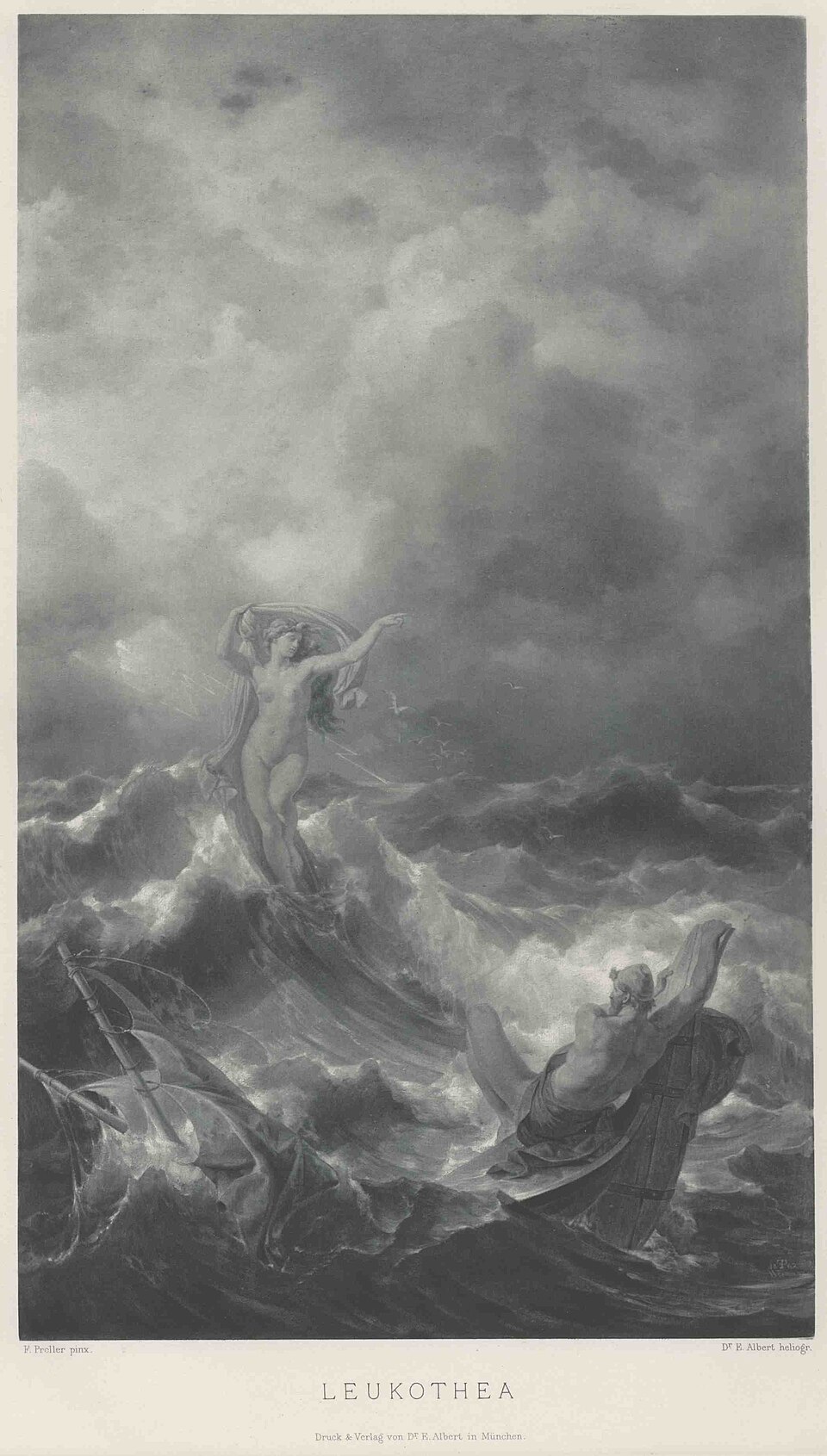
Then Poseidon, returning from a feast, spots the raft and remembers his blinded son. He stirs the sea into a chaos of wind from every direction, and a wave the size of a hillside tears the raft apart. What saves Odysseus is Ino Leucothea, the “white goddess” of the waves, who rises like a seabird and lends him her veil — with it, he cannot drown. He swims for two days and two nights and crawls ashore, naked and half dead, in the mouth of a river on the island of Scheria.
John Flaxman (1755–1826) was an English sculptor and draughtsman who began his career designing for Wedgwood pottery. His outline illustrations to Homer, Aeschylus and Dante made him famous across Europe, influencing a whole generation of Neoclassical artists.