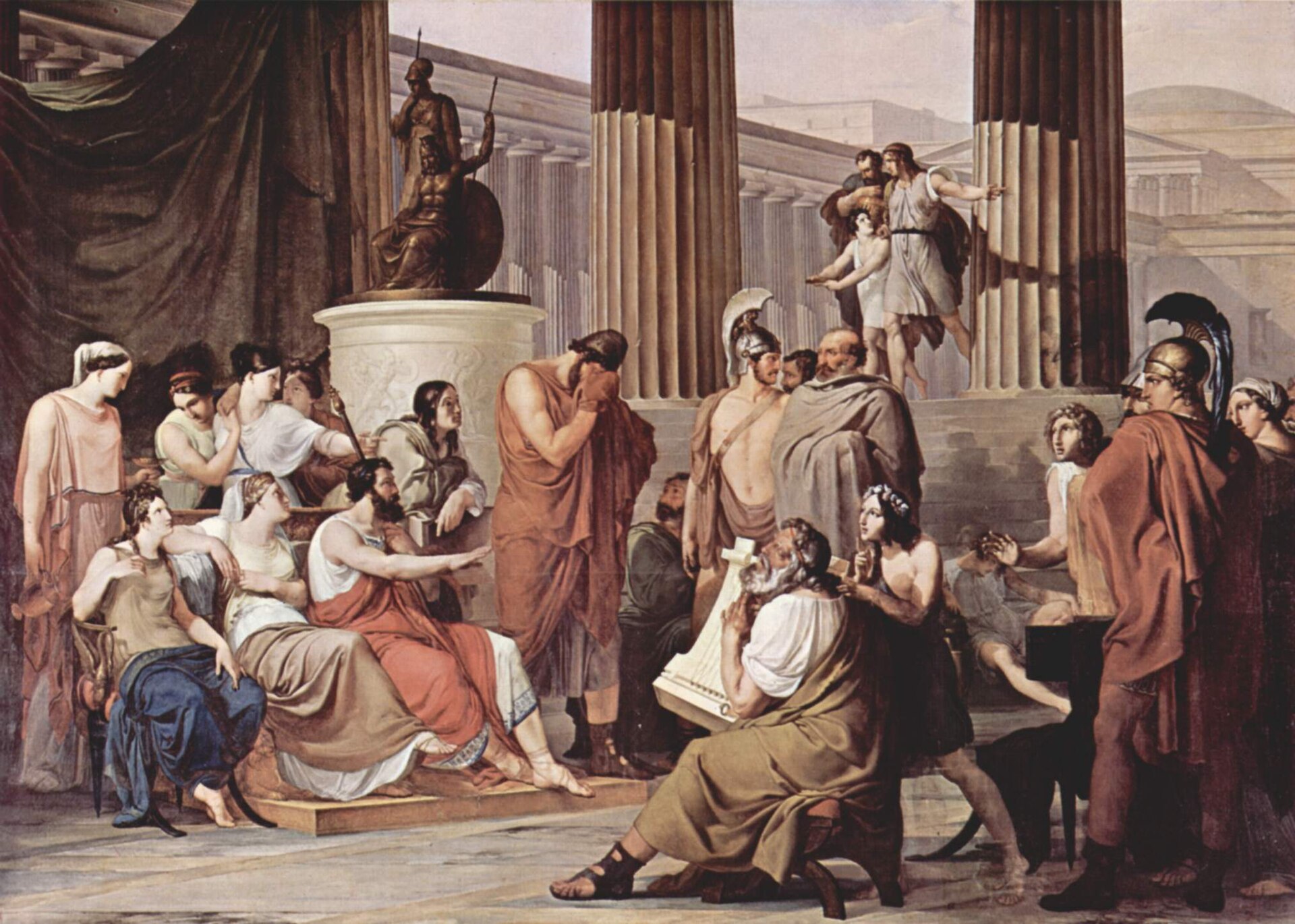
Ulysses at the Court of Alcinous

Odysseus sits as an unnamed guest in the bright hall of King Alcinous, and the blind bard sings — of Troy. Hearing his own story, the veteran hides his face and weeps, while the court begins to notice.
Hayez paints the moment just before the hero reveals his name, the hinge of the whole poem. The marble hall, the gathered court and the graceful groupings show the young painter working in the grand classical manner that would make him famous in Milan.
At the palace of Alcinous, Odysseus is treated the way Greeks believed strangers must be treated: bathed, fed, seated in honor, and entertained — all before anyone asks his name. Then the blind court bard Demodocus sings of the Trojan War, and the honored guest pulls his cloak over his face to hide that he is weeping. The king stops the music and asks the question directly. The answer: I am Odysseus, son of Laertes, known to all the world for my schemes.
Everything told so far — the Cyclops, Circe, the land of the dead, the Sirens, Scylla, the cattle of the sun, Calypso — he now tells the court himself, holding the hall spellbound through the night. This is the poem's famous design: its wildest adventures come from the hero's own mouth. The Phaeacians heap him with gifts and row him home overnight, laying him — asleep — on a beach on Ithaca, twenty years after he left it.
Francesco Hayez (1791–1882) became the leading painter of Italian Romanticism, best known today for The Kiss. He painted this Odyssey scene as a young man in Naples, at the start of a career that would last seven decades.