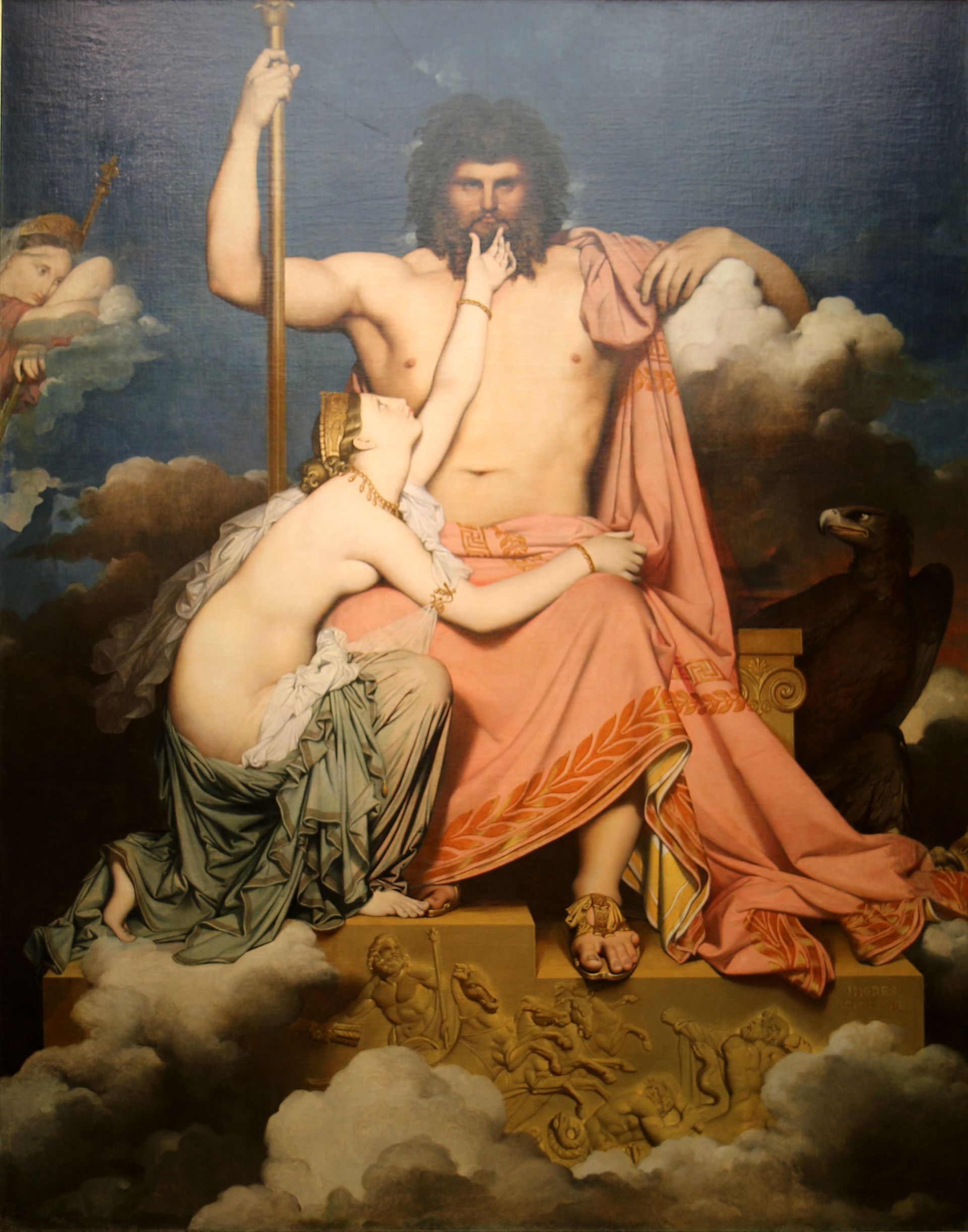
Jupiter and Thetis

Thetis, the sea-nymph mother of Achilles, has climbed to Olympus to beg a favor: let the Greeks start losing, so they will realize how much they need her dishonored son. She pours herself against Jupiter's body, one arm draped over his lap, her fingers reaching for his chin — the ancient gesture of supplication. He stares straight ahead, enormous, and does not move. At the far left, his jealous wife Juno watches from the clouds.
Ingres makes the power imbalance the whole picture: Jupiter is a frontal mountain of flesh and drapery, Thetis a boneless curve of pleading. Her rubbery, impossibly stretched neck and arm were mocked when the painting was shown, but that distortion is exactly what makes her seem liquid — a sea creature against a god of stone. Ingres painted it in Rome at thirty and considered it one of his most personal works.
Achilles wants more than to sulk. He wants the Greeks to lose, so they will learn what he is worth. He asks his mother for a favor only a goddess can deliver. Thetis rises to Olympus and kneels before Zeus — called Jupiter by the Romans — clasping his knees and touching his chin, the ancient posture of a beggar who cannot be refused.
Her request: let the Trojans win, and keep winning, until the Greeks come crawling back to her dishonored son. Zeus owes Thetis an old debt, and he nods — the nod that shakes Olympus and cannot be taken back. His wife Hera, who hates Troy, sees everything. From here on, the war on earth is mirrored by a quarrel in heaven.
Jean-Auguste-Dominique Ingres (1780–1867) was the standard-bearer of French classicism for half a century, insisting that line, not color, was the soul of painting. A student of Jacques-Louis David, he became famous for portraits and nudes of cool, polished perfection.