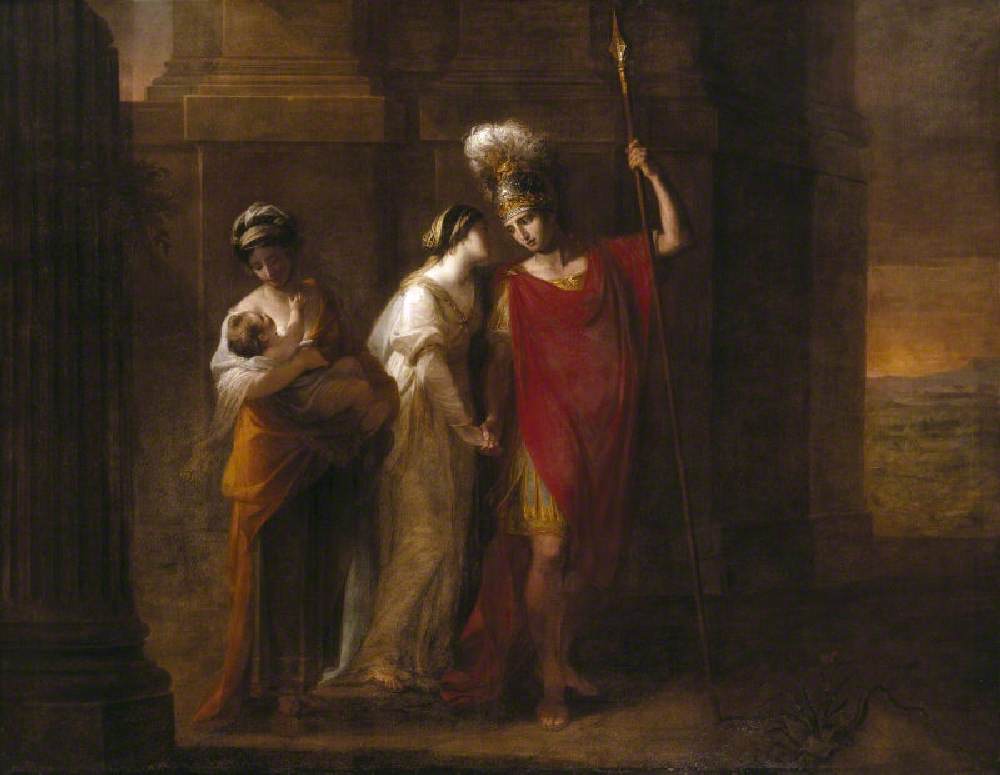
Hector Taking Leave of Andromache
At the gates of Troy, Hector says goodbye to his wife Andromache and their infant son before returning to battle. Andromache has just begged him to stay; the baby, in his nurse's arms, completes the small family group that the war is about to destroy.
Kauffman paints the scene with gentle restraint — soft colors, tender glances, grief held under good manners. It was one of four Homeric subjects she showed at the very first Royal Academy exhibition in 1769, announcing that a woman could paint history's grandest subjects. The set still hangs at Saltram, the house built to display them.
The fighting resumes without Achilles, and at first the Greeks hold their own — their champion Diomedes even wounds two gods, Aphrodite and Ares, with Athena's help. There is a truce for a duel: Paris against Menelaus, the two men the war is actually about. Menelaus wins easily, but Aphrodite whisks Paris off the field in a cloud before he can be killed. The war goes on.
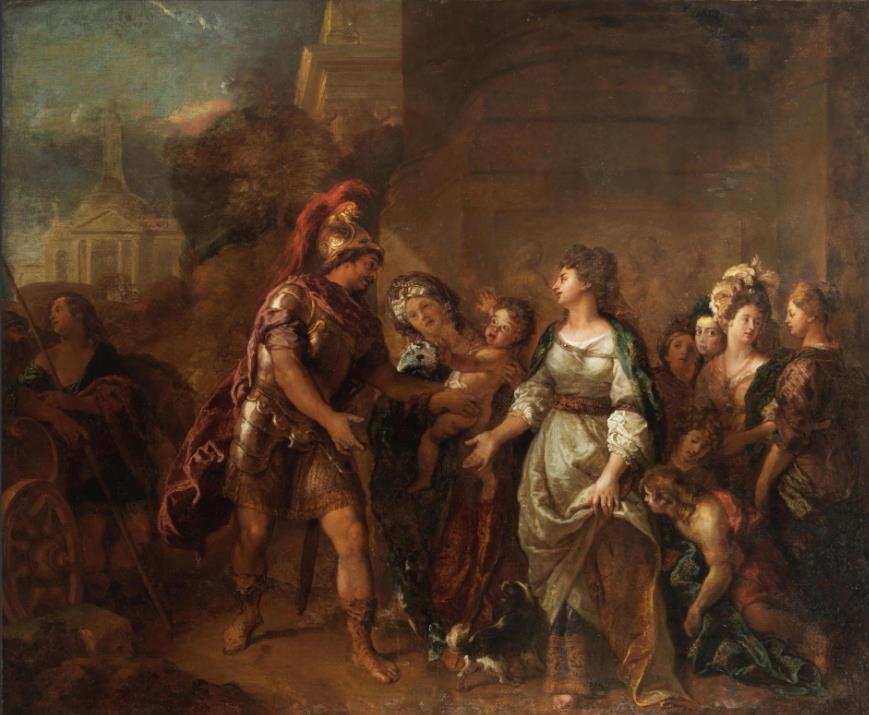
Inside Troy, Hector — Priam's eldest son and the city's one indispensable defender — goes home to find his wife Andromache and their baby son. Andromache begs him to fight from the walls. Achilles has already killed her father and her seven brothers; Hector is everything she has left.
Hector answers that he would die of shame if he hid from battle. He reaches for his son, and the baby screams — terrified of the huge bronze helmet with its horsehair crest. Hector laughs, takes the helmet off, kisses the boy, and prays that he will grow up to be a better man than his father. Then he goes back to the war. It is the most human scene Homer wrote, and everyone in it is doomed.
Angelica Kauffman (1741–1807) was a Swiss-born painter celebrated across Europe, and one of only two women among the founders of London's Royal Academy in 1768. She built an international career on portraits and refined classical scenes at a time when women were barred from most artistic training.
_-_Hector_Taking_Leave_of_Andromache_-_872177_-_National_Trust.jpg)