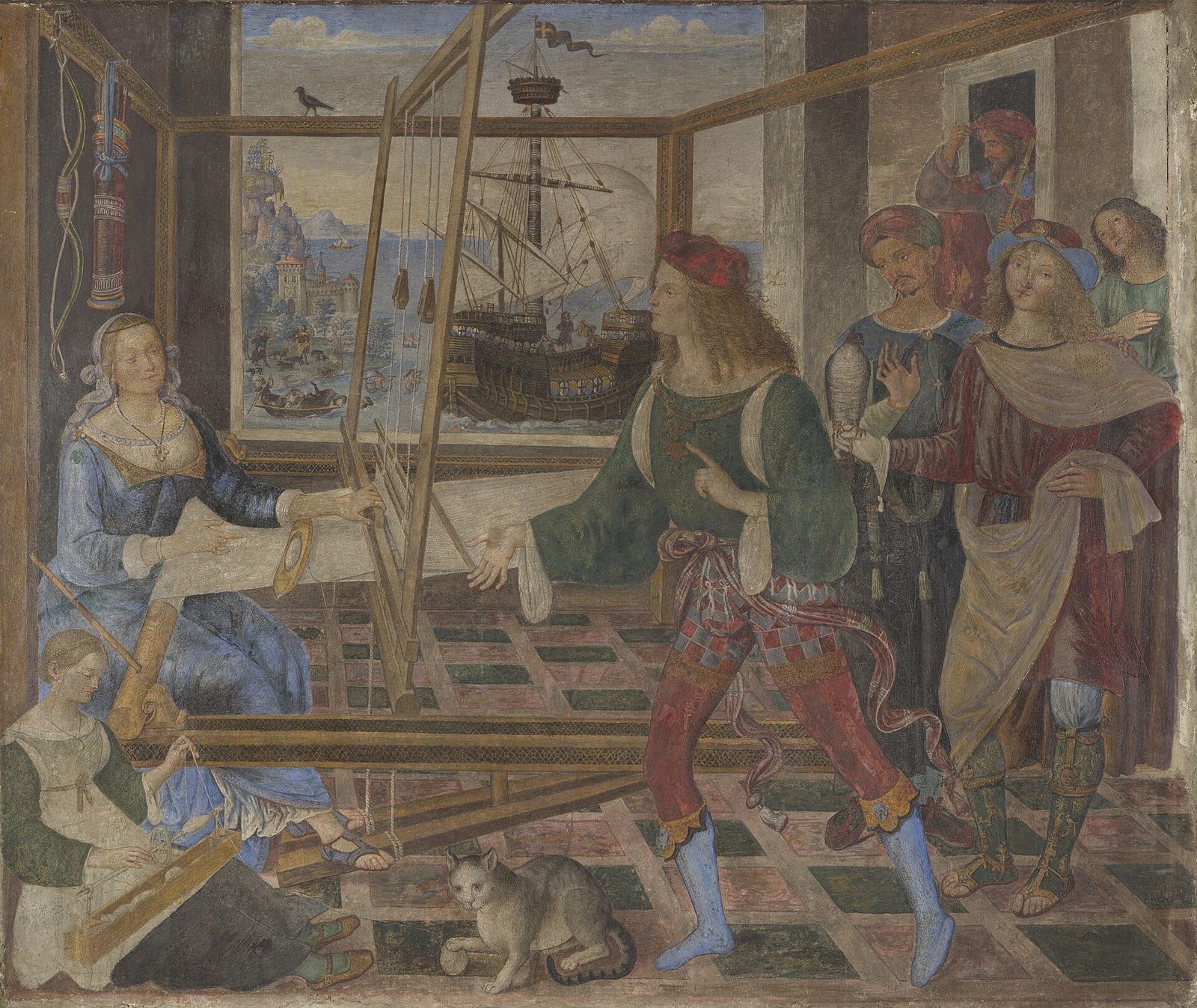
Penelope with the Suitors
Penelope stands at her great loom as the suitors crowd in through the door, one already spreading his hands in appeal. A cat plays with a ball of yarn at her feet. Through the window you can see the sea — and episodes of Odysseus's voyage, including his ship and the Sirens, painted like a story within the story.
The fresco was made around 1509 for a palace in Siena, and its point is choice: temptation walks in the door while faithfulness keeps its place at the loom. Packing the backstory into the window view is a very Renaissance solution.
The suitors are the poem's true villains: young, entitled, and certain Odysseus is bones on the sea floor. Their ringleaders, Antinous and Eurymachus, go as far as plotting to murder Telemachus — the son Odysseus left as a baby, now twenty and beginning to push back. Guided by Athena, Telemachus has sailed to the mainland to ask his father's old comrades Nestor and Menelaus for news, and he returns from the trip a grown man, slipping past the suitors' ambush on the way home.
This is the situation Odysseus wakes to on the beach. His palace is occupied, his son is marked for death, and he has no army. Athena disguises him as a ragged old beggar, and he goes first to the hut of Eumaeus, his loyal swineherd, who feeds the stranger and mourns his lost king to his face. There Odysseus reveals himself to his son. Father and son, who have never really known each other, sit down together and plan the counterattack.
Pintoricchio (Bernardino di Betto, c. 1454–1513) was an Umbrian Renaissance painter celebrated for richly decorated fresco cycles, including the Borgia Apartments in the Vatican and the Piccolomini Library in Siena.
.jpg)