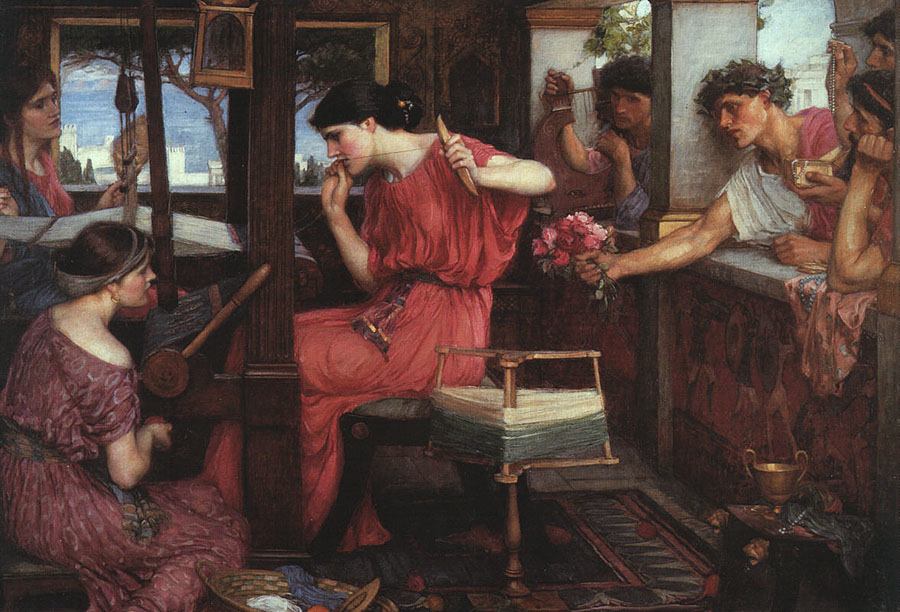
Penelope and the Suitors
Penelope bends over her weaving with her back to the window, winding thread, refusing to look up. Outside, the suitors press against the sill with roses, jewelry and music, competing for one glance they do not get.
Waterhouse turns the siege of the palace into a single architectural joke: a wall, a window, and a woman's turned back. All the color and flowers belong to the suitors; all the quiet dignity belongs to her.
The suitors are the poem's true villains: young, entitled, and certain Odysseus is bones on the sea floor. Their ringleaders, Antinous and Eurymachus, go as far as plotting to murder Telemachus — the son Odysseus left as a baby, now twenty and beginning to push back. Guided by Athena, Telemachus has sailed to the mainland to ask his father's old comrades Nestor and Menelaus for news, and he returns from the trip a grown man, slipping past the suitors' ambush on the way home.
This is the situation Odysseus wakes to on the beach. His palace is occupied, his son is marked for death, and he has no army. Athena disguises him as a ragged old beggar, and he goes first to the hut of Eumaeus, his loyal swineherd, who feeds the stranger and mourns his lost king to his face. There Odysseus reveals himself to his son. Father and son, who have never really known each other, sit down together and plan the counterattack.
John William Waterhouse (1849–1917) was an English painter who carried the Pre-Raphaelite love of myth and legend into the twentieth century. He is best known for The Lady of Shalott and his many paintings of dangerous and faithful women of classical story.
.jpg)