Odysseus and Penelope
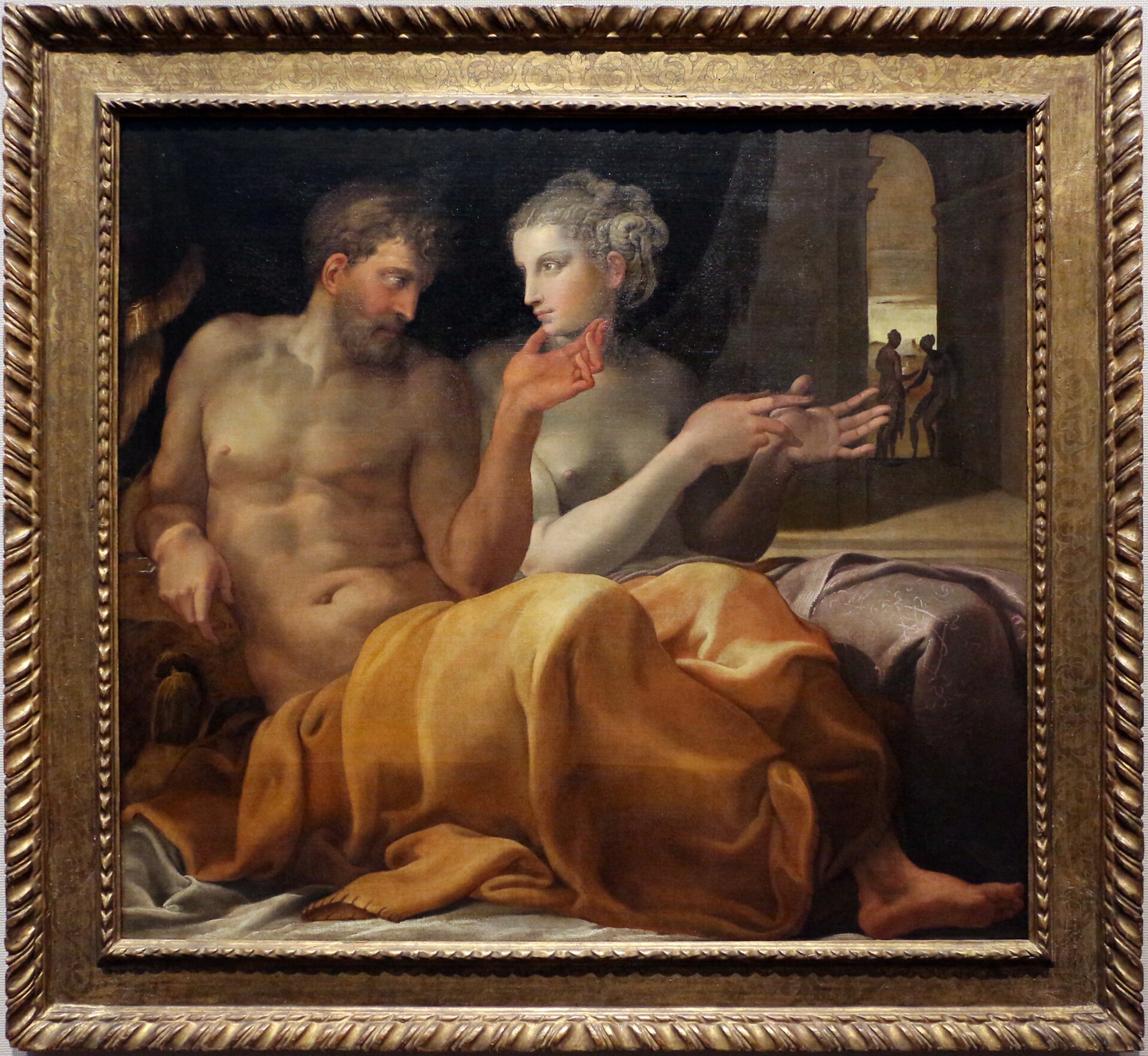
Husband and wife sit close together at last, and Odysseus counts off his adventures on his fingers as he tells Penelope everything — twenty years compressed into one night's talk. She leans her chin on her hand and listens, her eyes on his face.
The composition repeats a scene Primaticcio frescoed in the great Ulysses Gallery at Fontainebleau, which was demolished in 1738; this canvas is a rare survivor of that lost cycle. The closeness of the two heads, filling the frame, makes an epic end quietly domestic.
Penelope will not simply believe. Twenty years of rumors and con men have made her as wary as her husband, and the man by the fire, bathed and restored, could still be some god's trick. So she runs a test of her own. Within his hearing, she tells Eurycleia to move the great bed out of the bedchamber and make it up for the stranger there.
Odysseus flares up: no living man could move that bed. He built it himself around a living olive tree, trimming the trunk into a bedpost, and its roots still hold the ground — a secret only he, Penelope, and one maid have ever known. Her knees give way. She runs to him and holds on, and Homer says he was as welcome to her as the sight of land to a shipwrecked swimmer. Athena holds back the dawn to stretch the night. The next day Odysseus finds his old father Laertes in the orchard, and the goddess imposes peace on Ithaca. The long war and the long voyage are finally over.
Francesco Primaticcio (1504–1570) was a Bolognese painter who spent his career in France, leading the decoration of the royal château of Fontainebleau. His fifty-eight-scene Gallery of Ulysses there, later destroyed, was one of the most famous decorative cycles in Europe.