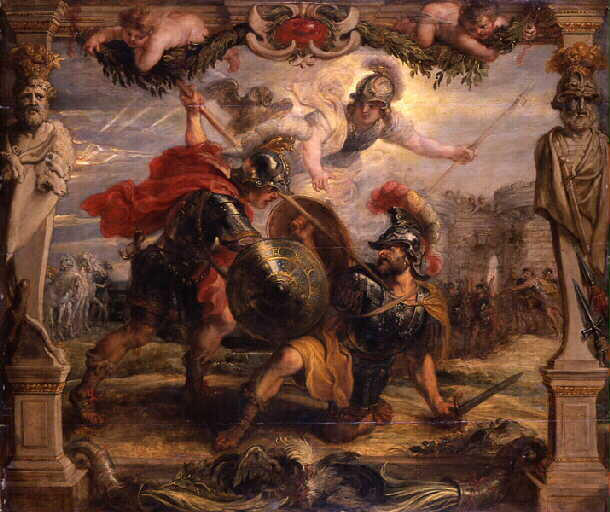
Achilles Slays Hector

The duel every reader waits for. Achilles drives his spear home and Hector buckles, his own weapon useless — while behind Achilles stands Minerva, the goddess who tricked Hector into standing his ground. Painted columns frame the fight like a stage.
This panel is one of Rubens' oil sketches for his Achilles tapestry series, which is why the border reads as architecture: it marks the woven frame to come. Rubens gives the killing no glamour — the goddess's presence quietly tells you the fight was never fair.
Achilles returns to battle and cuts through the Trojan army like fire through a field. He fights the river god Scamander, who rises against him choked with corpses. When the slaughter ends, every Trojan survivor is inside the walls — except one. Hector stands alone outside the gate, while his parents scream at him from the ramparts to come inside.
When Achilles comes for him, Hector's nerve breaks and he runs. Achilles chases him around the walls of Troy three times. Then Athena tricks Hector — she takes the shape of his brother and promises to fight beside him. He stops and turns. His spear bounces off the divine shield; when he looks around, the 'brother' is gone.
Achilles knows the one gap in his old armor — at the throat — and drives his spear through it. Dying, Hector begs him to return his body to his family. Achilles refuses: he says he wishes he could eat him raw. Troy's one indispensable man is dead, and everyone on both walls knows the city has just died with him.
Peter Paul Rubens (1577–1640), the great Flemish painter-diplomat, designed several cycles for tapestry — the most luxurious art form of his age. His fluent oil sketches for these projects, done entirely by his own hand, are among the most admired things he made.