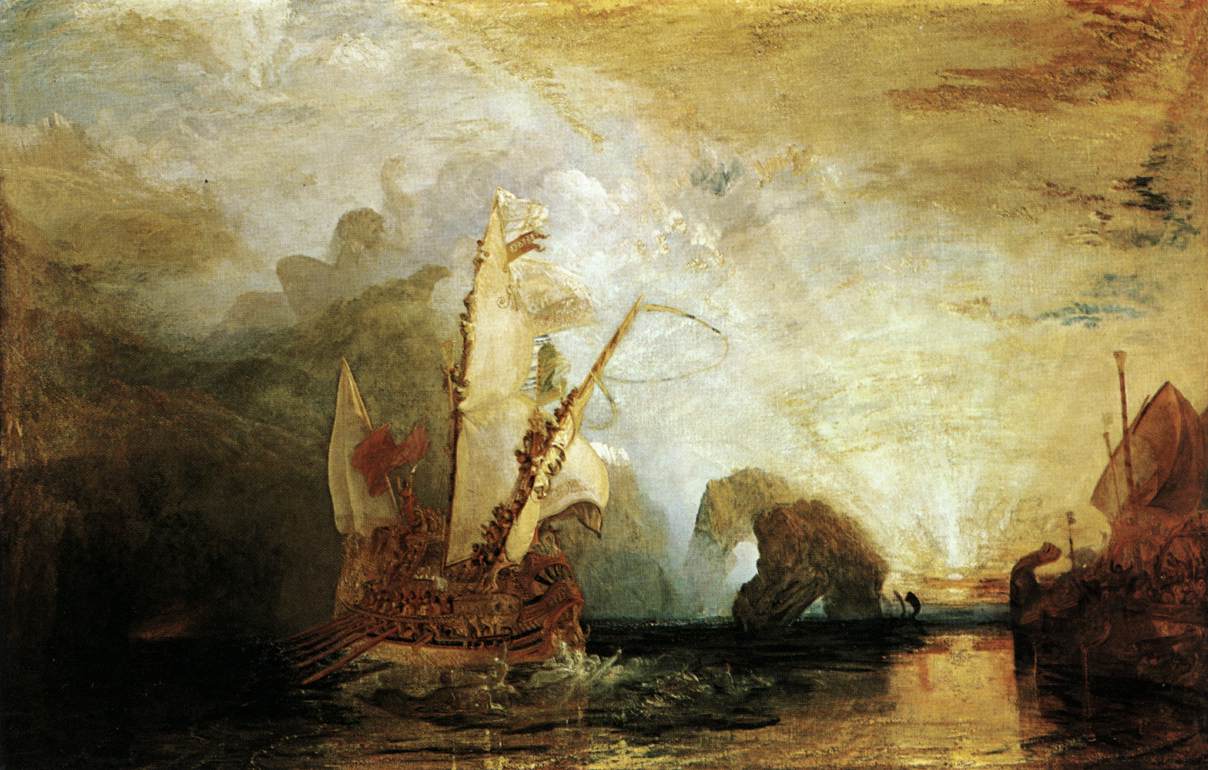
Ulysses Deriding Polyphemus
Ulysses' galley sails out of the giant's bay at sunrise, banners streaming, oars out, every sail set. High on the dark mountain at the left, Polyphemus is barely a shape — a wounded giant dissolving into cloud and smoke. Look closely at the bow of the ship: sea-nymphs glow faintly in the water, and the sun itself rises with the ghostly horses of Apollo's chariot in its glare.
Turner turns a revenge story into a painting about light. The hero's boast — the moment Ulysses shouts his real name and earns Poseidon's curse — matters less than the blazing sky that swallows everything. Many critics, led by John Ruskin, came to see this as the central picture of Turner's whole career.
In the morning the blinded Polyphemus rolls back the stone and feels the backs of his sheep as they file out, checking that no man rides them. Odysseus has thought of that too: he and his men slip out slung underneath the animals, clinging to the wool. They run for the ship and pull for open water.
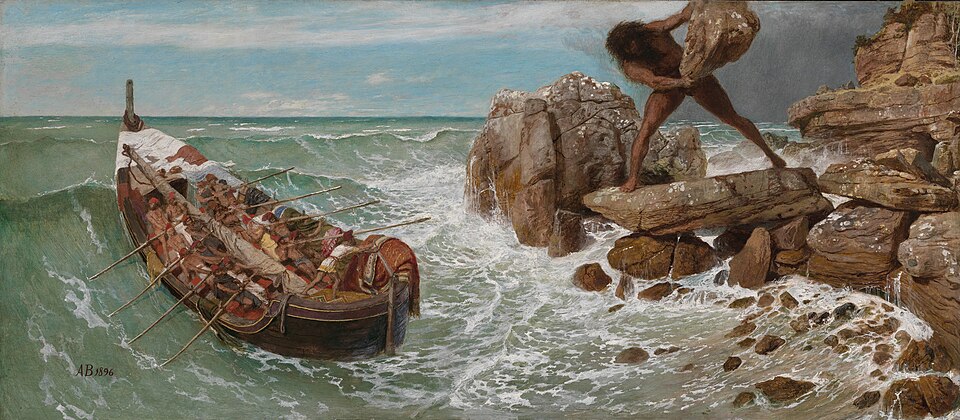
Then Odysseus makes the worst mistake of the voyage. He cannot resist shouting his real name back at the shore — tell them Odysseus of Ithaca blinded you. Polyphemus hurls half a hilltop at the sound of his voice, then prays to his father Poseidon: let this man lose every companion, wander for years, and come home late, alone, to trouble in his house. The sea god hears him. The rest of the Odyssey is that curse playing out.
J. M. W. Turner (1775–1851) was England's greatest painter of light, sea, and weather. A Royal Academy prodigy, he pushed landscape painting toward pure color and atmosphere, and his late works look almost abstract.