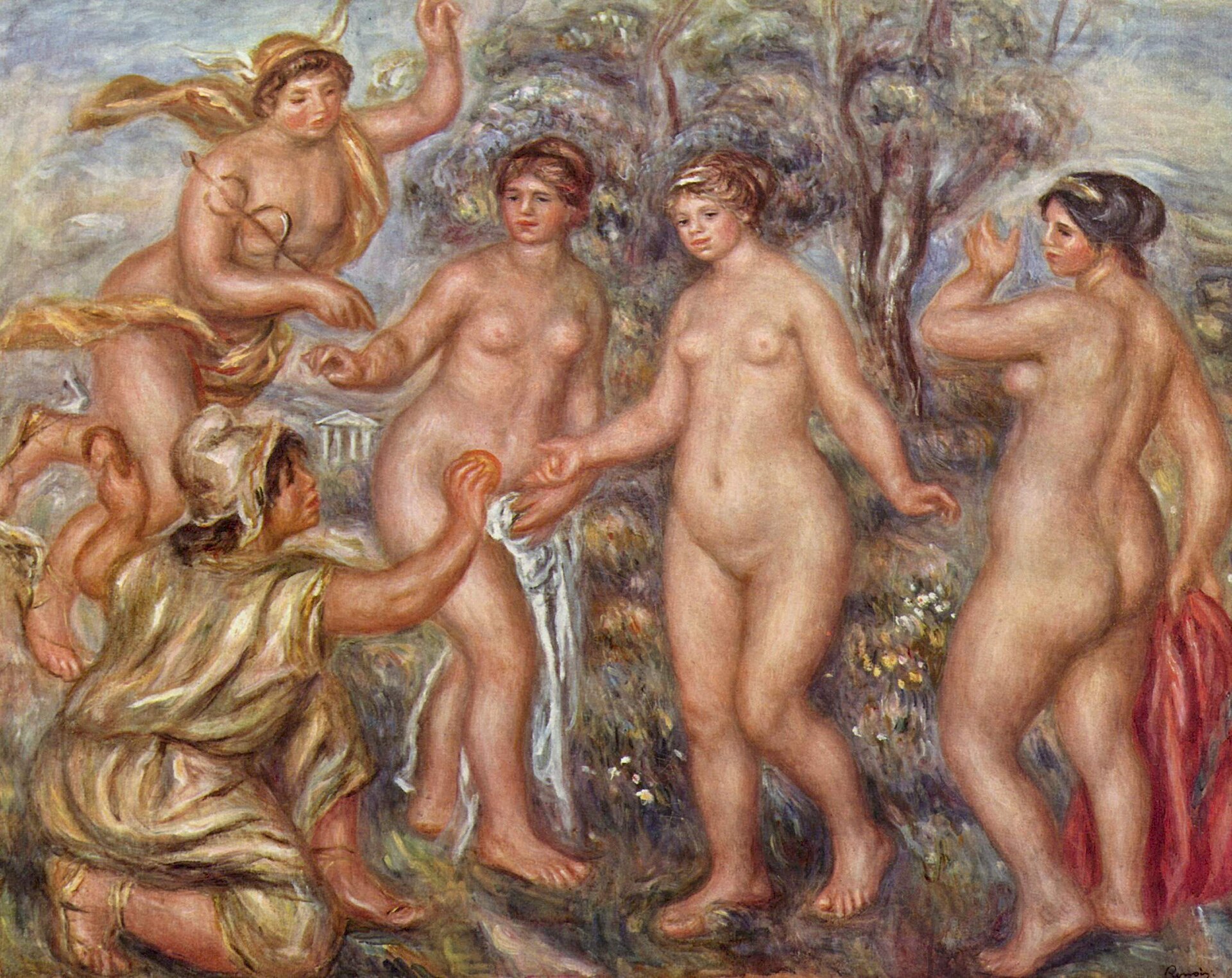
The Judgment of Paris
Renoir came to the myth at the end of his life. Paris, in a red Phrygian cap, holds out the apple to Venus while the three goddesses fill the canvas with the ample, glowing bodies of his late style. The landscape is a warm haze; nothing about the scene feels ancient or solemn.
By 1908 Renoir's hands were crippled by arthritis, yet he painted classical subjects with more appetite than ever, working the paint into soft reds and golds. His judgement of Paris is not about war to come — it is a celebration of the flesh Venus stands for, painted by a man who refused to stop.
The mortal Zeus picks is Paris, a prince of Troy who is living as a shepherd on Mount Ida. The three goddesses appear before him and each offers a bribe. Hera offers power — rule over all of Asia. Athena offers victory in every battle. Aphrodite offers the most beautiful woman in the world.
Paris gives the apple to Aphrodite. It is the worst decision in Greek mythology. The woman Aphrodite has promised him is Helen, queen of Sparta — and she is already married. Worse, Paris has just made permanent enemies of Hera and Athena, who will spend the coming war working for Troy's destruction.
Pierre-Auguste Renoir (1841–1919) was a founder of French Impressionism who later turned toward classical figure painting. In his final years, despite severe arthritis, he painted some of his most sensuous mythological nudes.